

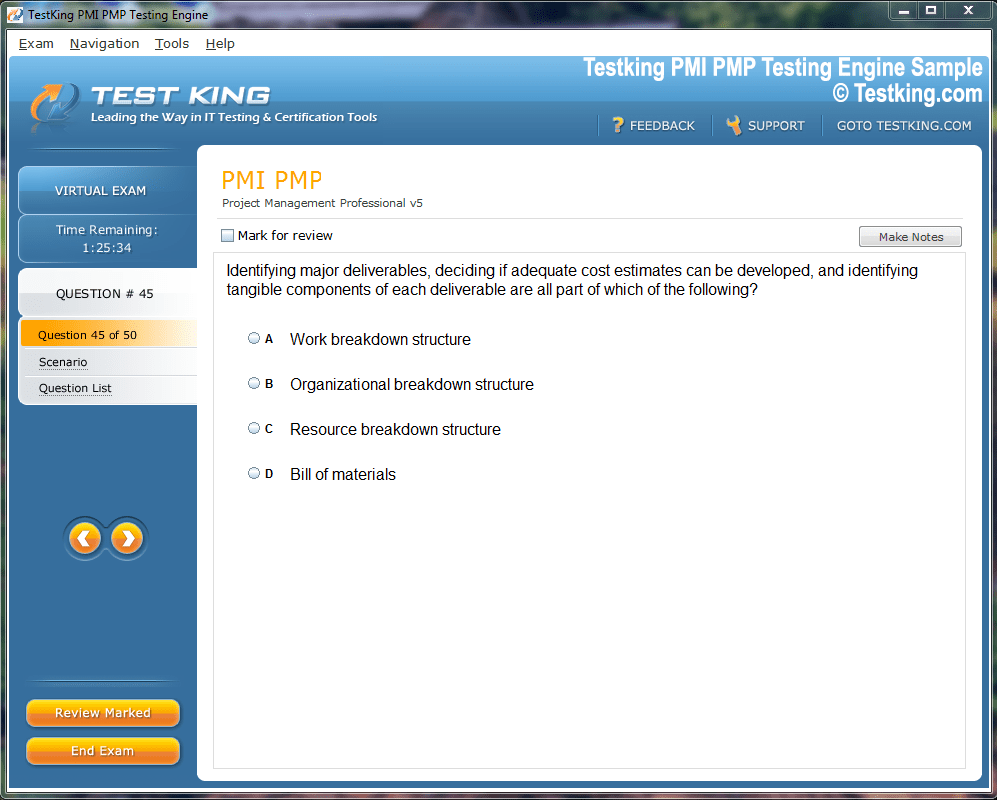
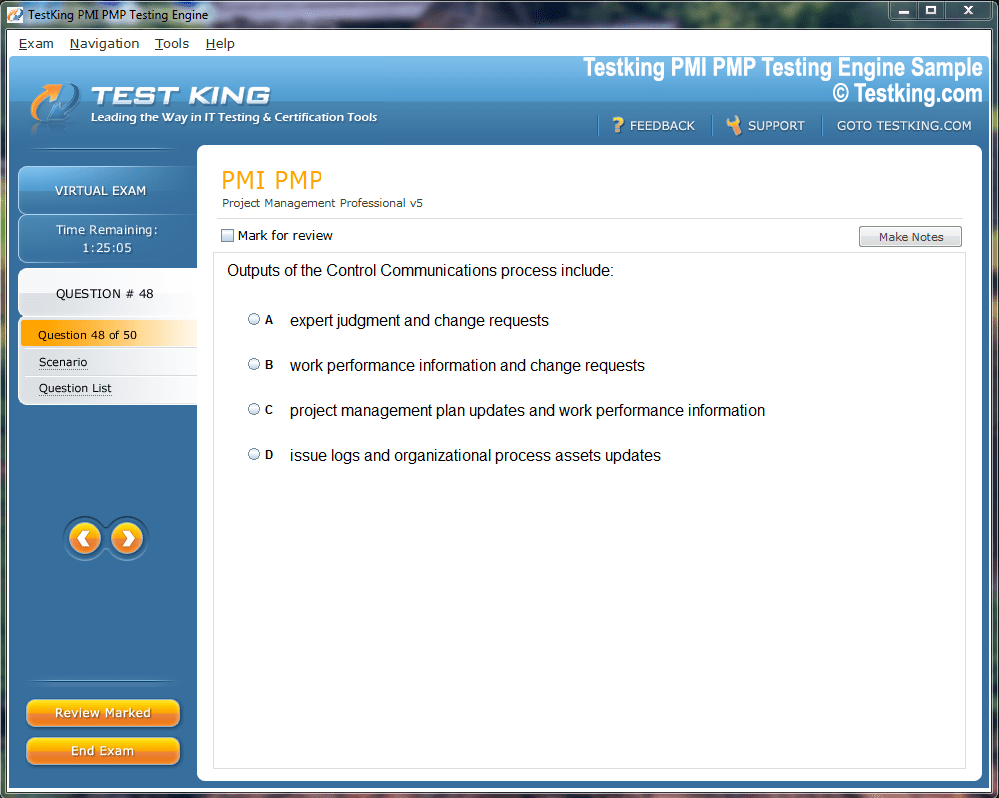
Product Screenshots
Frequently Asked Questions
Where can I download my products after I have completed the purchase?
Your products are available immediately after you have made the payment. You can download them from your Member's Area. Right after your purchase has been confirmed, the website will transfer you to Member's Area. All you will have to do is login and download the products you have purchased to your computer.
How long will my product be valid?
All Testking products are valid for 90 days from the date of purchase. These 90 days also cover updates that may come in during this time. This includes new questions, updates and changes by our editing team and more. These updates will be automatically downloaded to computer to make sure that you get the most updated version of your exam preparation materials.
How can I renew my products after the expiry date? Or do I need to purchase it again?
When your product expires after the 90 days, you don't need to purchase it again. Instead, you should head to your Member's Area, where there is an option of renewing your products with a 30% discount.
Please keep in mind that you need to renew your product to continue using it after the expiry date.
How many computers I can download Testking software on?
You can download your Testking products on the maximum number of 2 (two) computers/devices. To use the software on more than 2 machines, you need to purchase an additional subscription which can be easily done on the website. Please email support@testking.com if you need to use more than 5 (five) computers.
What operating systems are supported by your Testing Engine software?
Our TB0-111 testing engine is supported by all modern Windows editions, Android and iPhone/iPad versions. Mac and IOS versions of the software are now being developed. Please stay tuned for updates if you're interested in Mac and IOS versions of Testking software.
Ultimate Guide to Passing the Tibco TB0-111 Exam
The Tibco TB0-111 exam stands as a major professional milestone for individuals aiming to establish or enhance their expertise in Tibco technologies. Earning this certification is more than an academic accomplishment—it represents a candidate’s ability to design, implement, and manage enterprise-level integration solutions using the robust ecosystem of Tibco tools. The exam validates not only one’s technical proficiency but also strategic understanding, problem-solving skills, and capacity to drive organizational efficiency through automation and integration.
For professionals working in the fields of enterprise application integration, middleware development, or digital transformation, the TB0-111 credential serves as a powerful differentiator. It signifies a deep understanding of how systems communicate, how processes can be streamlined, and how technologies can align to achieve business agility. However, preparing for this exam is no small feat. It demands disciplined study, practical experience, and the ability to connect theory with real-world application. Candidates often experience a blend of excitement and apprehension—excitement for the opportunity to advance their careers, and trepidation for the challenge ahead.
To succeed, one must move beyond rote memorization and adopt a structured, methodical approach to learning. The path to mastery involves understanding not just what Tibco tools can do, but why and how they do it. Let us examine the exam’s structure, core topics, and effective preparation strategies in detail.
Understanding the Exam Structure
The TB0-111 exam is specifically designed to assess a candidate’s practical and theoretical understanding of Tibco’s suite of solutions. Unlike some certification tests that focus primarily on abstract theory, TB0-111 emphasizes application—testing how well candidates can interpret, design, and troubleshoot real-world integration environments.
The exam format typically consists of multiple-choice and scenario-based questions. Each question challenges the test-taker to demonstrate their grasp of core concepts such as messaging architecture, service-oriented design, and process automation. Some questions are straightforward and test conceptual clarity, while others present complex integration scenarios requiring analytical reasoning and technical intuition.
Success in the exam hinges on recognizing the underlying logic behind each question. Instead of relying on memorization, candidates should focus on understanding the principles that govern Tibco operations. For example, knowing how message queues differ from topics, or how a business process integrates with a messaging service, can enable the test-taker to reason through unfamiliar questions effectively.
Equally important is the ability to interpret diagrams and workflow representations. Many questions feature architectural sketches, sequence flows, or configuration snippets. Candidates who are adept at visual analysis can quickly discern data flow, bottlenecks, and process dependencies—skills that not only help in the exam but also in professional practice.
Core Topics to Master
Preparation for TB0-111 requires mastery across several core knowledge domains. Each area contributes to a holistic understanding of Tibco’s integration landscape.
Messaging Architecture and Services
At the heart of any Tibco implementation lies messaging—the backbone of inter-application communication. Candidates must understand how queues, topics, and channels operate within the Tibco ecosystem. Concepts such as message persistence, reliability, delivery modes, and durable subscriptions often appear on the exam and are vital in production environments.
Equally critical is familiarity with Tibco EMS (Enterprise Message Service)—its configuration, administration, and tuning. Understanding how messages are routed, how producers and consumers interact, and how to manage message selectors or filters is indispensable.
Integration Patterns
Integration patterns define the structural and behavioral blueprints for connecting diverse systems. Candidates should study classical patterns such as publish-subscribe, request-reply, and content-based routing. Understanding when and why to use each pattern demonstrates not only theoretical knowledge but also practical wisdom.
Furthermore, Tibco’s design philosophy encourages modular, reusable components. Mastery of adapter configuration, service mediation, and data transformation ensures seamless interoperability between heterogeneous systems—an ability that directly aligns with enterprise integration best practices.
Process Automation and Workflow Management
A major strength of Tibco technology lies in its capability for process orchestration and automation. Candidates must be proficient in designing and deploying workflows using tools such as Tibco BusinessWorks (BW). This includes knowledge of process models, activities, transitions, and fault-tolerance mechanisms.
A strong candidate will understand how to manage workflow execution, monitor system performance, and handle exceptions gracefully. Familiarity with error handling, logging, and transaction management is essential, as these aspects ensure reliability and maintainability in real-world deployments.
Monitoring, Troubleshooting, and Optimization
System optimization and monitoring represent another major domain in the exam. Candidates should be familiar with Tibco Administrator, Hawk, and other monitoring utilities. These tools enable administrators to manage configurations, track system health, and detect anomalies before they escalate into major issues.
Understanding how to interpret logs, trace message paths, and fine-tune performance parameters can make a decisive difference both in the exam and on the job. The ability to troubleshoot issues effectively demonstrates mastery beyond theoretical knowledge—it reflects the capacity to sustain operational excellence.
Study Strategies for Deep Comprehension
A successful study plan for the TB0-111 exam integrates theory, application, and reflection. While many candidates approach preparation through reading guides or watching tutorials, true mastery comes from active engagement with the material.
Develop a Structured Study Plan
Begin by mapping out a comprehensive study schedule that divides the syllabus into manageable segments. Allocate dedicated time for each core topic—messaging, integration, automation, and monitoring—and set milestones for progress. Having a structured plan instills discipline and prevents last-minute cramming.
Use Active Recall and Spaced Repetition
Passive reading is rarely effective for long-term retention. Instead, employ active recall—regularly testing yourself without referring to notes. This technique strengthens memory by forcing your brain to retrieve information rather than merely re-expose it. Combine this with spaced repetition, where challenging topics are revisited periodically to ensure the information remains fresh.
Engage in Practical Exercises
Theory must be reinforced through practice. Set up a personal lab or sandbox environment to simulate real Tibco implementations. Experiment with message flows, process configurations, and adapter setups. This hands-on engagement not only deepens understanding but also makes learning enjoyable and meaningful.
Leverage Study Communities and Peer Learning
Participating in online forums, study groups, or professional communities provides exposure to diverse perspectives. Discussing real-world problems and sharing solutions with peers helps uncover blind spots and solidifies understanding.
Leveraging Practical Experience
While theoretical knowledge is the foundation of exam preparation, practical experience is the bridge that connects learning to performance. Candidates with hands-on exposure to Tibco tools tend to perform better because they can visualize how abstract concepts manifest in actual systems.
Setting up end-to-end integration scenarios—for example, connecting a database to an enterprise application via Tibco BusinessWorks—helps in understanding component dependencies and potential failure points. Likewise, experimenting with error handling or monitoring in real-time strengthens troubleshooting skills.
Real-world experience also helps develop the intuition needed for scenario-based questions. These often describe complex environments, asking candidates to identify the most efficient or reliable solution. Practical exposure allows test-takers to reason from experience, making them more confident under pressure.
Time Management During Preparation and the Exam
Time management is a recurring theme in both exam preparation and exam execution. Effective scheduling ensures that no topic is neglected, while disciplined pacing during the test maximizes performance.
During Preparation
Adopt a balanced study rhythm—intensive learning sessions followed by short breaks to prevent burnout. A common and effective technique is the Pomodoro method, which involves 25–30 minutes of focused study followed by a brief rest.
Regular mock exams are indispensable. Simulating exam conditions familiarizes you with the time constraints and cognitive pressure of the actual test. Analyzing performance on these mock exams helps identify weak areas for focused review.
During the Exam
When taking the actual TB0-111 exam, begin by skimming through all questions to identify the easy ones. Answering these first builds momentum and confidence. For more complex questions, mark them for review and return later. This approach ensures steady progress while maximizing accuracy.
Avoid spending too much time on any single question. Remember, the goal is not perfection on one question but competence across all. Time discipline is a crucial factor separating successful candidates from those who struggle.
Building a Conceptual Framework
Rather than viewing the TB0-111 syllabus as a list of disconnected topics, candidates should aim to construct a cohesive conceptual framework. This involves understanding how different Tibco components interact to form a complete integration ecosystem.
For instance, how does a message generated by one system move through a queue, get processed by a workflow, and eventually trigger a downstream service? Seeing the big picture transforms isolated facts into interconnected knowledge.
This approach encourages systems thinking—a mindset that understands cause and effect across components. When candidates grasp relationships instead of isolated mechanisms, they can handle unfamiliar exam questions by logically deducing answers from foundational principles.
Embracing Cognitive Flexibility
Modern enterprise environments are dynamic, and so is the TB0-111 exam. Candidates often encounter questions framed in unconventional ways or combining multiple topics. Here, cognitive flexibility—the ability to adapt one’s thinking to novel situations—becomes invaluable.
Cultivating this flexibility involves challenging yourself with diverse practice scenarios. Instead of rehearsing only straightforward examples, experiment with ambiguous or complex cases. Discussing these with peers or mentors helps expose alternative approaches and strengthens adaptive reasoning.
Reflective learning also contributes to flexibility. After each study session or lab exercise, take a few minutes to analyze what worked, what didn’t, and why. This reflection transforms experience into wisdom, ensuring lessons are internalized rather than forgotten.
Maintaining Motivation and Resilience
The TB0-111 journey can be demanding. It requires persistence, curiosity, and resilience in the face of setbacks. Maintaining motivation throughout preparation is just as important as mastering the material.
Set achievable goals—small wins such as completing a topic or passing a mock test keep morale high. Celebrate progress and remind yourself that certification is a cumulative achievement built through consistent effort.
Developing resilience means viewing mistakes as opportunities to learn. Every failed configuration or incorrect practice answer reveals a gap to fill. With the right mindset, each error becomes a stepping stone toward mastery.
Final Thoughts: Beyond Certification
Earning the Tibco TB0-111 certification is more than a career milestone—it signifies a transformation in how professionals think about integration and automation. The preparation journey develops critical skills: analytical reasoning, structured problem-solving, and the ability to synthesize complex systems into coherent solutions.
Certified professionals gain not only recognition but also confidence to tackle sophisticated integration projects, optimize enterprise workflows, and contribute to organizational innovation. The knowledge acquired through this process remains valuable far beyond the exam itself—it forms the foundation for lifelong learning and career growth in enterprise integration.
Ultimately, the TB0-111 exam is not a test of memorization but a validation of understanding, experience, and adaptability. Those who approach it with curiosity, discipline, and practical engagement emerge not only as certified professionals but as capable architects of enterprise transformation.
The initial phase of preparation for the TB0-111 exam emphasizes foundational understanding, practical engagement, and strategic study habits. By familiarizing oneself with the exam structure, mastering core topics, and building a cohesive conceptual framework, candidates lay the groundwork for success. Integrating hands-on practice, time management techniques, and cognitive flexibility further enhances readiness, transforming preparation from a purely theoretical exercise into a dynamic, applied process.
Approaching the exam with a methodical and holistic mindset not only improves performance but also cultivates skills that resonate beyond the certification itself. The journey toward mastering Tibco TB0-111 is thus a blend of knowledge acquisition, experiential learning, and intellectual refinement—a process that prepares candidates to excel both in the exam and in professional practice.
Delving Deeper into Messaging Architecture
A profound and nuanced understanding of messaging architecture forms the cornerstone of success in the TIBCO TB0-111 certification exam. Within TIBCO’s ecosystem, messaging frameworks serve as the communication backbone that connects disparate systems and applications, ensuring that data flows seamlessly across the enterprise landscape. These frameworks are designed to deliver reliability, scalability, and efficiency—three qualities that are essential in any mission-critical integration environment.
To truly grasp messaging architecture, candidates must go beyond memorizing definitions and instead develop an intuitive comprehension of topics, queues, and channels—the fundamental constructs that determine how messages are transmitted, prioritized, routed, and consumed. Topics enable the publish-subscribe paradigm, allowing multiple consumers to receive messages simultaneously, while queues support point-to-point delivery, ensuring that each message is consumed exactly once. Channels, on the other hand, define the logical pathways through which messages travel, controlling flow and guaranteeing message integrity.
Exam questions often test the candidate’s ability to distinguish between these configurations and apply them effectively in different operational contexts. Understanding when to use synchronous versus asynchronous messaging is crucial: synchronous messaging ensures immediate feedback but may increase latency, whereas asynchronous messaging enhances scalability and decoupling at the cost of instant acknowledgment. Similarly, knowledge of durable subscriptions—where subscribers receive messages even if temporarily offline—and message persistence—which guarantees delivery even in the event of failures—can be the difference between a pass and a fail on the TB0-111 exam.
Beyond theoretical understanding, hands-on practice remains indispensable. Setting up messaging configurations, experimenting with message priorities, and analyzing the performance implications of different delivery modes help translate concepts into applied skills. By simulating production-like environments and observing system behavior, candidates gain the confidence and practical insight needed to not only excel in the exam but also perform effectively in real-world enterprise integration projects.
Mastering Integration Patterns
Integration patterns form the structural foundation of enterprise application orchestration, and they are integral to the TB0-111 examination. Each pattern embodies a time-tested solution to a recurring problem in distributed systems. Among the most significant are the publish-subscribe, request-reply, message routing, and transformation flow patterns—all of which must be understood both conceptually and contextually.
The publish-subscribe pattern promotes scalability and decoupling by enabling one-to-many communication. It is ideal for broadcasting updates or events to multiple systems simultaneously. In contrast, the request-reply pattern facilitates synchronous exchanges, where a client sends a request and awaits a direct response—a design suitable for transactional or query-based operations. Message routing patterns govern the path a message follows through the system, often employing content-based or rule-based logic to direct messages to appropriate destinations. Lastly, transformation patterns ensure compatibility between systems by converting message formats, structures, or protocols as needed.
Understanding these patterns in isolation is insufficient. The TB0-111 exam often challenges candidates to select and combine patterns appropriately to address complex scenarios. For example, a solution may require blending publish-subscribe for event dissemination with request-reply for acknowledgment handling. Successful candidates develop the analytical ability to evaluate trade-offs among performance, reliability, and complexity when choosing a pattern.
To build this skill, scenario-based exercises are invaluable. Designing and implementing integrations that incorporate multiple patterns—then testing how each behaves under varying loads—deepens comprehension. Such practice instills a natural intuition for recognizing which pattern suits a given problem, a capability that extends well beyond the exam into professional system design.
Process Automation and Workflow Management
Another pillar of the TB0-111 exam is process automation, which encapsulates the design, deployment, and optimization of orchestrated workflows. TIBCO’s process orchestration tools empower enterprises to automate business operations, reduce manual intervention, and improve consistency and visibility across applications.
Candidates must master how to design workflows that accurately model business logic, handle dependencies among tasks, and apply conditional branching to accommodate dynamic decision paths. For instance, configuring workflow tasks that execute sequentially, in parallel, or conditionally based on runtime data is a skill central to both exam success and enterprise efficiency.
Error handling and recovery mechanisms are equally vital. No workflow, no matter how well-designed, is immune to unexpected conditions—timeouts, data inconsistencies, or downstream service failures. Candidates should understand how to build resilient workflows that gracefully manage such failures without compromising data integrity or process continuity. Effective strategies include implementing exception handling, compensating transactions, and retry logic to ensure reliability.
The TB0-111 exam also assesses awareness of logging, monitoring, and auditing mechanisms within process automation. These features are essential for diagnosing issues, maintaining transparency, and ensuring regulatory compliance. Candidates who practice deploying automated workflows, monitoring execution in real-time, and analyzing failure points will be well-prepared for both the exam and professional integration challenges.
Data Transformation and Mapping
Data transformation is a cornerstone of integration architecture. In heterogeneous environments, applications often use different data structures, encodings, or semantics. The ability to map and transform data accurately ensures smooth communication between systems and maintains data integrity throughout the workflow.
The TB0-111 exam evaluates candidates’ proficiency in using TIBCO’s transformation tools and schema management techniques. Understanding how to convert data between XML, JSON, flat files, and other representations is essential. Candidates should also know how to define and apply XSLT mappings, schema validations, and format conversions.
Attention to edge cases—such as missing fields, inconsistent date formats, or mismatched data types—can distinguish a proficient integrator from a novice. Developing sample transformations and rigorously validating their outputs reinforces both conceptual understanding and precision.
In practice, accurate transformation design not only prevents data corruption but also enhances performance, as poorly structured mappings can increase processing overhead. By engaging in continuous experimentation, candidates develop fluency in aligning schemas, normalizing datasets, and ensuring semantic consistency across platforms—a competency that serves both exam requirements and enterprise integration success.
Troubleshooting Techniques for Complex Systems
Troubleshooting is one of the most practical and frequently tested skills on the TB0-111 exam. Real-world integration environments are dynamic, involving multiple interconnected components, each of which can introduce potential points of failure. The ability to diagnose and resolve issues methodically is a defining characteristic of a capable TIBCO professional.
Candidates should learn to adopt a systematic troubleshooting approach. This involves identifying symptoms, analyzing logs, isolating faulty components, and formulating corrective measures. Understanding how to interpret error codes, review message traces, and inspect configuration files is essential.
Practicing controlled failure simulations is a powerful way to build this expertise. By intentionally misconfiguring components or overloading message queues, candidates can observe how failures propagate and how the system reacts under stress. Such exercises develop the intuition required to pinpoint bottlenecks, recognize performance anomalies, and apply targeted fixes efficiently.
Troubleshooting proficiency is not merely technical—it also reflects one’s problem-solving mindset. The TB0-111 exam rewards candidates who demonstrate logical reasoning and practical insight rather than rote memorization of error codes. Cultivating this mindset ensures readiness for both exam scenarios and real-world operational environments.
Performance Optimization Strategies
Performance optimization occupies a subtle yet crucial role in enterprise integration. An architect’s goal is to design systems that achieve low latency, high throughput, and efficient resource utilization. The TB0-111 exam includes questions that probe understanding of how to achieve these qualities in TIBCO environments.
Candidates should be familiar with concepts like load balancing, thread management, connection pooling, and message prioritization. Each configuration choice influences system performance. For example, increasing thread counts can enhance concurrency but may also increase contention if not managed carefully. Similarly, adjusting message batch sizes affects both processing speed and memory consumption.
Hands-on experimentation offers invaluable insight into these trade-offs. Candidates who build small performance testing environments—modifying parameters and measuring the outcomes—develop an instinct for balancing competing objectives.
Equally important is understanding scalability principles: designing integrations that can grow horizontally by adding nodes or vertically by allocating more resources. By evaluating how different architectures behave under load, candidates refine their ability to craft systems that sustain performance at scale—a critical skill for both the exam and enterprise operations.
Security Considerations in TIBCO Environments
As enterprises increasingly operate in interconnected digital ecosystems, security becomes a paramount concern. The TB0-111 exam emphasizes a candidate’s grasp of the principles that safeguard data, systems, and communications within TIBCO environments.
Key areas include authentication, authorization, and data protection. Candidates should understand how to implement role-based access control (RBAC) to restrict system functions based on user roles, and how to configure encryption mechanisms to secure data both in transit and at rest. Secure transport protocols such as HTTPS and SSL/TLS play a pivotal role in protecting message confidentiality and integrity.
Beyond configuration, candidates must appreciate the architectural implications of security. For example, introducing encryption may increase CPU utilization, while overly restrictive access policies can impede integration flexibility. Recognizing and managing these trade-offs is vital.
Practical exercises—such as enabling secure message channels, testing access permissions, and simulating unauthorized access attempts—help reinforce security awareness. In today’s regulatory landscape, where compliance frameworks like GDPR and HIPAA govern data handling, cultivating a security-first mindset is essential not only for exam success but also for professional credibility.
Simulating Real-World Scenarios
Theoretical understanding alone rarely guarantees exam success. The TB0-111 exam is designed to assess applied competence—the ability to synthesize knowledge and solve realistic integration challenges. Thus, simulating real-world scenarios forms one of the most effective preparation strategies.
Candidates should build environments that combine multiple TIBCO components—such as EMS, BusinessWorks, and adapters—to emulate genuine enterprise architectures. By experimenting with end-to-end workflows that involve messaging, transformation, and orchestration, one gains insights into system behavior under varied conditions.
These simulations encourage adaptive thinking. Candidates learn to identify potential bottlenecks, evaluate alternative designs, and measure outcomes empirically. Such experiential learning develops the flexibility required to handle complex, scenario-based questions on the TB0-111 exam, which often test reasoning more than recall.
Furthermore, real-world simulation fosters cross-disciplinary understanding. Integrating different subsystems forces candidates to think holistically—about data flow, latency, fault tolerance, and operational monitoring—just as they would in a professional setting.
Developing a Problem-Solving Mindset
Ultimately, success in the TB0-111 exam—and in enterprise integration at large—depends on cultivating a strategic, problem-solving mindset. Technical proficiency forms the foundation, but analytical thinking, adaptability, and composure under pressure define excellence.
Candidates should train themselves to approach challenges methodically: first identifying the problem, then analyzing constraints, generating alternative solutions, and evaluating the consequences of each. This structured reasoning process transforms technical knowledge into actionable insight.
Engaging regularly with complex exercises that simulate real-world ambiguity helps strengthen cognitive flexibility. After each challenge, reflecting on what worked, what failed, and why promotes continuous improvement. Over time, this habit builds intellectual resilience and confidence—qualities indispensable during high-stakes exams and professional decision-making.
In essence, preparing for TB0-111 is not merely about memorizing commands or configurations. It is about thinking like an integration architect—balancing performance, security, maintainability, and business goals through informed judgment. Those who internalize this mindset not only excel in the exam but also distinguish themselves as competent, forward-thinking professionals capable of driving enterprise integration success.
Candidates who immerse themselves in practical exercises, simulate real-world scenarios, and cultivate analytical thinking build a robust skill set that aligns with both the TB0-111 exam requirements and professional expectations.
By focusing on integration patterns, performance optimization, security considerations, and adaptive problem-solving, aspirants enhance their readiness and confidence. This stage of preparation consolidates theoretical understanding with applied practice, forming a comprehensive foundation for tackling the most challenging aspects of the TB0-111 certification exam.
Advanced Messaging Concepts
As candidates progress in TB0-111 preparation, it becomes essential to grasp advanced messaging concepts. Tibco environments rely on a variety of messaging paradigms that influence performance, reliability, and scalability. Understanding persistent versus non-persistent messages, durable subscriptions, and topic hierarchies ensures candidates can design robust communication frameworks.
Advanced messaging scenarios often involve complex routing, filtering, and prioritization. Practicing these configurations in lab environments helps internalize message propagation patterns and enables one to anticipate potential conflicts or inefficiencies. Developing this level of mastery allows candidates to respond to intricate exam questions with confidence and precision.
Event-Driven Architecture and Its Importance
Event-driven architecture underpins many modern integration solutions, making it a critical area for TB0-111 exam mastery. Candidates should comprehend how events trigger workflows, propagate through messaging channels, and drive business logic execution. Understanding event queues, listeners, and triggers is vital for designing responsive systems that handle high volumes of asynchronous operations.
Practical exercises that simulate event storms or cascading triggers enhance comprehension. These exercises reveal potential pitfalls such as message loss, bottlenecks, or redundant processing. Exposure to such dynamics prepares candidates to apply principles effectively in both exam scenarios and real-world implementations.
Workflow Optimization Techniques
Optimizing workflows is a nuanced skill that extends beyond simple automation. TB0-111 evaluates candidates’ ability to enhance process efficiency, reduce latency, and maintain system reliability. Techniques such as parallel task execution, load balancing, and dependency management are central to achieving these objectives.
Hands-on practice with workflow configuration allows candidates to experiment with optimization strategies. Observing the effects of task sequencing, conditional branching, and resource allocation cultivates an intuitive understanding of system performance. Such experience is invaluable for scenario-based exam questions that assess analytical reasoning under constrained conditions.
Error Handling and Exception Management
Robust error handling is a hallmark of proficient Tibco practitioners. The TB0-111 exam often tests knowledge of strategies to detect, isolate, and rectify failures within complex processes. Candidates must understand the mechanisms for retry policies, error queues, and exception notifications.
Simulating fault conditions in a controlled environment provides practical insight. By observing how errors propagate and experimenting with remediation techniques, candidates develop resilience and analytical acuity. Mastery of these concepts ensures exam readiness and equips professionals to maintain operational stability in enterprise settings.
Monitoring and Diagnostic Strategies
Effective monitoring and diagnostics are essential for sustaining system health. Candidates should become familiar with logging frameworks, performance counters, and alerting mechanisms. Understanding how to interpret these indicators allows one to identify performance bottlenecks, misconfigurations, or anomalous behavior.
Practical exercises in monitoring include generating synthetic loads, observing system responses, and analyzing logs for patterns. These activities cultivate an investigative mindset, enabling candidates to approach complex TB0-111 questions methodically. The ability to diagnose issues accurately also enhances confidence during time-pressured exam situations.
Security Best Practices
Security considerations extend beyond access control to encompass data integrity, confidentiality, and compliance. TB0-111 requires candidates to understand encryption techniques, secure communication protocols, and authentication mechanisms. Implementing role-based access and understanding the principle of least privilege are essential skills.
Hands-on exercises that simulate secure message transmission, certificate management, and user authorization reinforce theoretical concepts. Familiarity with these practices ensures candidates can address security-centric exam questions with clarity and demonstrates readiness to implement secure enterprise solutions.
Real-World Scenario Simulations
To bridge the gap between knowledge and application, simulating real-world scenarios is invaluable. Candidates should construct complex exercises combining multiple components, workflows, and messaging paradigms. These simulations challenge one to integrate concepts holistically and anticipate potential complications.
Such exercises cultivate adaptive thinking, allowing candidates to evaluate alternatives, weigh trade-offs, and implement optimal solutions. Exposure to diverse scenarios fosters the problem-solving agility necessary to tackle the most intricate TB0-111 exam questions.
Analytical Thinking and Decision Making
TB0-111 exam success hinges on analytical thinking and sound decision-making. Candidates must evaluate scenarios critically, identify constraints, and choose solutions that balance efficiency, reliability, and maintainability. Reflective practice, including post-exercise analysis and consideration of alternative approaches, strengthens this cognitive skill.
Developing analytical rigor equips candidates to navigate novel problems effectively. By internalizing principles and patterns rather than memorizing solutions, candidates cultivate intellectual flexibility that benefits both the exam and professional practice.
Performance Tuning in Tibco Environments
Performance tuning involves optimizing throughput, minimizing latency, and ensuring efficient resource utilization. Candidates should explore techniques such as message batching, load distribution, and system resource allocation. Observing the impact of these adjustments in test environments fosters practical understanding.
Exam questions often present scenarios requiring quick evaluation of performance trade-offs. By practicing tuning exercises, candidates gain the ability to analyze options rapidly, predict outcomes, and select optimal configurations under time constraints. This skill enhances both exam performance and operational competence.
Continuous Improvement Mindset
Adopting a mindset of continuous improvement is crucial for long-term mastery of Tibco systems. Candidates should cultivate habits of iterative learning, reflective practice, and proactive problem-solving. Engaging with challenging exercises, reviewing errors, and exploring alternative strategies fosters resilience and adaptability.
This mindset ensures that preparation for the TB0-111 exam extends beyond rote memorization. It encourages deep understanding, intellectual curiosity, and practical proficiency, all of which are indispensable for both certification success and professional growth in complex integration environments.
Advanced Workflow Design Principles
As preparation for the TB0-111 certification exam advances, mastering advanced workflow design principles becomes a cornerstone of success. Designing workflows is far more than simply automating a set of repetitive tasks; it is about creating an intelligent orchestration of interdependent activities that align with business objectives while minimizing system latency and resource contention. A well-structured workflow balances logical sequencing, parallel execution, conditional routing, and fault tolerance to achieve both efficiency and robustness.
Candidates preparing for the exam should develop a deep understanding of workflow decomposition, in which complex processes are broken into modular components that can be independently tested, maintained, and reused. This modularity improves scalability and enables smoother troubleshooting. Additionally, exposure to parallel processing—executing multiple tasks concurrently to maximize throughput—is critical for designing workflows that operate efficiently in high-volume environments. Similarly, conditional branching allows workflows to respond dynamically to contextual data, ensuring that only relevant pathways are executed, thereby optimizing resource usage.
Equally important is the concept of dynamic task allocation, where tasks are assigned at runtime based on workload, system state, or predefined rules. By experimenting with workflow simulations using tools that mimic real-time integration environments, candidates can observe how different design decisions affect performance metrics such as latency, throughput, and reliability. This practical experience fosters intuition—an invaluable asset when facing the complex, scenario-based questions often found in the TB0-111 exam.
Moreover, candidates should practice workflow optimization techniques like dependency reduction, asynchronous event handling, and exception-driven rerouting. Through this hands-on exploration, they develop not only the technical skill to construct resilient workflows but also the judgment to design with efficiency and maintainability in mind.
Event Correlation and Processing
Event correlation represents one of the more sophisticated and intellectually demanding aspects of Tibco systems. It involves understanding how multiple events—originating from diverse systems or components—relate to one another to trigger specific responses or modify the overall state of the system. In the TB0-111 exam, questions about event correlation often test a candidate’s ability to identify patterns, determine dependencies, and orchestrate event-driven actions in complex, real-time environments.
Successful candidates recognize that event correlation can take several forms, including event aggregation (combining related events to form a complete context), event sequencing (ensuring the correct temporal order of processing), and event prioritization (assigning importance levels to concurrent events). These techniques collectively enable systems to act intelligently, reducing redundant processing and avoiding race conditions.
Hands-on practice is crucial here. Candidates can simulate multiple event streams, inject time delays, or create artificial overlaps to test how systems handle concurrency and ordering. Observing these reactions in controlled scenarios deepens understanding of how Tibco engines manage state transitions, correlation identifiers, and message persistence.
This kind of experiential learning helps cultivate the analytical precision required in the exam. It trains candidates to evaluate cause-and-effect relationships between events, predict system behavior, and design event-driven architectures that are both responsive and efficient.
Advanced Messaging and Queue Management
Beyond the basics of message exchange, advanced messaging and queue management principles lie at the core of robust enterprise integration. The TB0-111 exam frequently assesses a candidate’s ability to design messaging systems that are both high-performance and fault-tolerant.
Candidates must understand message prioritization, transaction management, and dead-letter queue (DLQ) strategies. Prioritization ensures that critical messages are processed first, reducing latency for business-critical operations. Transaction management guarantees data integrity during distributed operations, while DLQs capture failed or undeliverable messages for later inspection—helping to prevent data loss and facilitate debugging.
Hands-on experimentation is invaluable. Candidates should configure message persistence settings, adjust queue capacity parameters, and simulate high-load scenarios to observe how the system behaves under stress. Experimenting with transactional boundaries and persistence mechanisms reveals how to balance durability and performance.
Furthermore, understanding message acknowledgment patterns (such as auto-acknowledge and client-acknowledge) and flow control techniques helps prevent bottlenecks. These insights enable candidates to design systems that can gracefully handle bursts in traffic and recover smoothly from partial failures. When applied to TB0-111 exam scenarios, this practical experience translates directly into confident, evidence-based reasoning.
Data Validation and Transformation Complexities
Data validation and transformation lie at the heart of any integration architecture. The TB0-111 exam often evaluates a candidate’s ability to maintain data consistency and semantic integrity while transferring information across heterogeneous systems.
Effective data validation ensures that all input conforms to expected schemas and business rules before it is processed. Candidates must be able to handle complex transformations, including type conversions (for instance, string-to-integer mapping), schema reconciliation, and conditional data mapping—where transformation logic changes based on input context.
Simulating real-world data integration scenarios helps candidates uncover the subtle challenges inherent in transformation logic. Examples include missing fields, type mismatches, or nested structures that don’t align between systems. By building strategies such as schema evolution, transformation templates, and error handling routines, candidates gain the practical problem-solving ability necessary for exam success.
Mastery in this area not only ensures a solid TB0-111 performance but also prepares candidates for professional integration challenges, where accurate and reliable data handling underpins business continuity.
Performance Monitoring and Analytics
Monitoring system performance is essential for optimizing Tibco solutions and is an area often explored in the TB0-111 exam. Candidates must be comfortable interpreting key metrics—throughput, latency, error rates, and resource utilization—and understanding how these metrics drive optimization decisions.
Through performance testing and load simulation, candidates can observe how various configurations affect system stability and responsiveness. This process sharpens the ability to correlate performance metrics with underlying causes such as inefficient workflow design, unbalanced queues, or improper transaction settings.
Moreover, developing familiarity with Tibco’s built-in monitoring tools and external analytic dashboards allows candidates to visualize data trends and make informed adjustments. The goal is to cultivate predictive insight—the ability to anticipate performance degradation before it occurs.
By practicing this analytical approach, candidates develop a well-rounded skill set that aligns technical understanding with strategic foresight—an advantage that not only boosts exam performance but also prepares them for operational excellence in real-world deployments.
Troubleshooting Advanced Integration Scenarios
In complex integration environments, even small misconfigurations can lead to elusive errors. The TB0-111 exam frequently tests a candidate’s ability to systematically troubleshoot issues such as message loss, workflow deadlocks, and configuration conflicts.
Effective troubleshooting begins with structured observation: isolating the faulty component, reviewing logs, and reproducing the problem under controlled conditions. Candidates should practice diagnosing issues like broken event links, data mapping failures, and transaction rollbacks, developing a mental model of how information flows through a Tibco ecosystem.
By simulating these fault conditions, candidates learn how to trace dependencies, verify message delivery guarantees, and restore service continuity efficiently. This approach reinforces a mindset of methodical investigation—a crucial skill for both the exam and professional practice.
Security Implementation in Complex Systems
Security in modern Tibco environments extends beyond encryption and authentication; it encompasses multi-layered access control, secure messaging, and compliance management. The TB0-111 exam assesses whether candidates can design, configure, and maintain security within distributed, multi-component architectures.
Key areas include role-based access control (RBAC), certificate management, data-in-transit encryption, and audit logging. Candidates should also understand how to implement security policies that align with regulatory frameworks such as GDPR or HIPAA, depending on organizational context.
Practical exercises are essential: setting up secure queues, enforcing certificate-based authentication, and testing unauthorized access scenarios. These experiments not only strengthen theoretical knowledge but also highlight the trade-offs between security rigidity and system performance.
Ultimately, mastering security implementation equips candidates with the foresight to build resilient, compliant systems—a competency that the TB0-111 exam seeks to measure comprehensively.
Scenario-Based Practice Strategies
One of the most effective ways to prepare for the TB0-111 exam is through scenario-based practice. This strategy involves designing and executing multi-component integration exercises that combine messaging systems, workflows, event-driven processes, and error-handling mechanisms.
Such practice sessions reveal inter-component dependencies, potential bottlenecks, and configuration pitfalls. Candidates who iteratively refine their implementations after each simulation develop a reflective problem-solving mindset—the same analytical agility required to navigate complex exam scenarios.
These exercises also help candidates internalize key principles instead of memorizing facts. When they encounter an unfamiliar question during the exam, they can rely on the conceptual frameworks and troubleshooting skills gained through practice to reason their way to the correct answer.
Leveraging Analytical Reasoning
Analytical reasoning is a distinguishing factor in TB0-111 success. The exam does not simply test recall; it challenges candidates to evaluate multi-layered scenarios, identify dependencies, and choose the most effective solutions under constraints.
Developing strong analytical reasoning requires consistent reflection after practice exercises. Candidates should review what worked, what failed, and why. Comparing alternative solutions and analyzing trade-offs builds cognitive flexibility—the ability to pivot strategies when faced with new information.
By adopting a structured reasoning process, candidates can approach even unfamiliar exam items confidently. Instead of guessing, they rely on logic: dissecting the question, eliminating irrelevant data, and prioritizing efficiency and reliability. This mindset transforms rote learning into adaptive intelligence—an essential quality for both exam performance and professional success.
Preparing for Exam-Day Dynamics
Preparation for the TB0-111 exam extends beyond technical mastery. Candidates must also manage exam-day dynamics, including time pressure, stress, and cognitive endurance. Simulating timed tests helps build pacing skills, allowing candidates to allocate time efficiently among question types.
Understanding the exam’s structure and weight distribution—for example, how many questions focus on workflows versus security—enables strategic focus. Practicing multiple-choice elimination techniques and identifying key question cues can significantly improve accuracy.
Equally important is psychological readiness. Confidence comes from repeated simulation, review, and self-assessment. Candidates who enter the exam with a balanced mindset—calm, alert, and self-assured—perform more consistently, even under challenging conditions.
Cultivating a Strategic Mindset
A strategic mindset unites technical proficiency with planning, adaptability, and resilience. Successful candidates view TB0-111 preparation as a long-term investment rather than a short-term hurdle. They integrate hands-on experimentation, theoretical study, and reflective analysis into a cohesive preparation plan.
This holistic approach ensures that knowledge is not just exam-ready but professionally relevant. It equips candidates to think like architects rather than operators—designing systems that are efficient, secure, and scalable. By cultivating strategy and adaptability, candidates position themselves for success both on the exam and in their broader careers as integration professionals.
Mastering Deployment Strategies
Successful deployment of Tibco solutions is a critical aspect of TB0-111 exam preparation. Candidates must understand various deployment methodologies, including single-node, clustered, and distributed configurations. Mastery of these approaches ensures systems are resilient, scalable, and maintainable.
Hands-on practice with deployment scenarios allows candidates to experience challenges such as load balancing, failover mechanisms, and environment-specific configurations. By simulating these situations, aspirants gain practical insights into the operational dynamics of complex integration ecosystems, reinforcing their readiness for exam questions that test applied knowledge.
Configuring High Availability Systems
High availability is a central theme in enterprise integration and a significant component of TB0-111. Candidates should grasp techniques to ensure system uptime, including redundant nodes, failover processes, and load distribution strategies.
Practical exercises that simulate node failures, service interruptions, and recovery protocols enhance comprehension. Understanding these mechanisms not only prepares candidates for exam questions but also equips them to design systems capable of withstanding real-world operational stresses.
Advanced Error Detection and Recovery
Beyond basic troubleshooting, TB0-111 assesses candidates on advanced error detection and recovery mechanisms. This includes identifying subtle failure patterns, managing exception workflows, and implementing automatic recovery strategies.
Simulating failure scenarios, such as delayed message delivery or workflow deadlocks, strengthens analytical skills. Candidates learn to diagnose root causes methodically, assess the impact of corrective measures, and optimize processes for long-term stability. This experiential knowledge is invaluable for exam readiness and professional competence.
Integrating Heterogeneous Systems
Integration of heterogeneous systems is a frequent requirement in enterprise environments. TB0-111 examines the ability to bridge disparate applications, manage data flow consistency, and handle diverse communication protocols.
Practical exercises involving the integration of different databases, messaging protocols, and application platforms help candidates internalize best practices. Understanding data transformation, message mapping, and interface consistency ensures that candidates can address scenario-based exam questions confidently and accurately.
Optimization of Resource Utilization
Efficient resource utilization is a subtle yet essential skill for both the TB0-111 exam and professional practice. Candidates should explore strategies such as message batching, thread management, and memory allocation optimization.
Testing these configurations in controlled environments allows candidates to observe performance impacts and develop predictive reasoning. This understanding enables rapid assessment of trade-offs in exam scenarios, enhancing decision-making under time constraints while ensuring optimal system performance.
Enhancing Security Protocols
Security remains an integral component of advanced Tibco implementations. Candidates must understand encryption techniques, secure communication channels, and access control policies. Implementing security protocols correctly ensures data integrity, confidentiality, and regulatory compliance.
Practical exercises, such as configuring certificate-based authentication, secure messaging, and role-based permissions, reinforce theoretical understanding. These skills are directly relevant to scenario-based questions in TB0-111, demonstrating the candidate’s capacity to manage secure, enterprise-grade systems.
Performance Analysis and Tuning
Performance analysis and tuning require both analytical and practical skills. TB0-111 evaluates candidates on their ability to identify bottlenecks, monitor throughput, and adjust system parameters for optimal performance.
Simulating high-load scenarios, analyzing logs, and adjusting configurations allow candidates to develop a nuanced understanding of system behavior. This approach ensures they can answer complex performance-related exam questions while gaining competencies essential for professional practice.
Scenario-Based Problem Solving
Scenario-based problem solving is a recurring theme in TB0-111. Candidates should engage with exercises that simulate multi-component workflows, diverse messaging patterns, and event-driven processes.
By approaching problems holistically, analyzing constraints, and evaluating alternatives, candidates cultivate adaptive thinking. These skills enable them to select optimal solutions under pressure, mirroring the analytical requirements of the actual exam and real-world Tibco implementations.
Building Cognitive Agility
Cognitive agility—the capacity to switch between different problem-solving strategies fluidly—is vital for TB0-111 success. Candidates should practice interpreting complex scenarios, anticipating potential complications, and evaluating multiple solution pathways.
Exercises that challenge reasoning under uncertainty, combined with reflective review, foster mental flexibility. This agility allows candidates to approach unfamiliar exam questions confidently and make well-informed decisions efficiently.
Embracing Reflective Learning
Reflective learning reinforces knowledge retention and problem-solving ability. After completing practical exercises or practice exams, candidates should review their approaches, identify mistakes, and explore alternative strategies.
This iterative process deepens understanding, strengthens memory, and cultivates a mindset of continuous improvement. Embracing reflective learning ensures that preparation for TB0-111 extends beyond memorization, equipping candidates with a robust, applicable skill set for both certification and professional application.
Preparing for Complex Scenario Questions
TB0-111 features complex scenario questions designed to assess a candidate’s integrated knowledge and applied skills. Candidates should familiarize themselves with question structures, practice analyzing multi-step problems, and develop strategies for evaluating trade-offs and dependencies.
Simulated practice and reflective analysis allow candidates to anticipate challenges and refine their approach. By internalizing principles and patterns, candidates can respond to scenario-based questions with confidence, accuracy, and efficiency.
Consolidating Core Knowledge
As candidates reach the final stage of their TB0-111 certification journey, the consolidation of core knowledge becomes an essential phase in achieving mastery. This process involves more than a simple review of concepts; it requires an intentional synthesis of foundational principles across the full Tibco integration spectrum, including messaging, workflow orchestration, event-driven architecture, and data transformation. Through the deliberate reinforcement of these building blocks, candidates establish a durable mental framework that supports strategic reasoning and reliable problem-solving under exam conditions.
Revisiting earlier study materials, particularly lab exercises and scenario-based challenges, enables a deeper understanding of how theoretical concepts translate into practical application. Candidates should not only recall definitions and configurations but also focus on interrelationships—how message queues interact with workflows, how data transformations influence event propagation, and how orchestration affects performance. By doing so, they cultivate a systems-oriented mindset that is critical for the TB0-111 exam, where questions often integrate multiple knowledge domains.
Engaging in reflective review sessions strengthens both memory retention and conceptual linkage. This iterative revisiting of material transforms passive review into active consolidation, ensuring that knowledge is not merely memorized but internalized. Over time, candidates develop the mental agility to apply principles in novel contexts—a hallmark of true exam readiness and professional competence.
Integrating Practical Experience
Practical experience remains one of the most decisive factors in achieving TB0-111 certification success. While conceptual understanding provides a theoretical foundation, hands-on experimentation transforms that understanding into skillful execution. Candidates are encouraged to integrate lab exercises, workflow simulations, and messaging experiments into their regular study regimen. These experiences bring the Tibco ecosystem to life, bridging the gap between knowledge and application.
Through direct engagement with integration tools, candidates encounter the nuances of configuration, deployment, and runtime behavior. Adjusting parameters, fine-tuning message persistence, or reconfiguring service interactions exposes learners to the underlying mechanics of system performance. Moreover, hands-on practice uncovers common pitfalls—such as misconfigured queues, workflow synchronization errors, or data transformation mismatches—that might otherwise remain abstract in theoretical study.
These experiences help build intuition: a candidate’s ability to foresee the effects of certain design choices or predict how systems will behave under different loads. This intuition proves invaluable not only during the exam but also in professional environments where quick, informed decision-making is vital. Integrating this form of practical engagement ensures that candidates evolve beyond rote learning, becoming proficient practitioners capable of applying knowledge flexibly and efficiently.
Advanced Error Mitigation Techniques
Error mitigation at an advanced level requires analytical precision and foresight. The TB0-111 exam frequently challenges candidates to anticipate points of failure, design resilient architectures, and implement systematic recovery mechanisms. Effective error mitigation strategies hinge on three key competencies: detection, diagnosis, and correction.
Detection involves monitoring system health through logging, alerting, and correlation mechanisms. Candidates must learn to identify early indicators of issues—such as message buildup in queues or delayed event processing—before these escalate into systemic failures. Diagnosis, the second competency, demands the ability to isolate root causes quickly by analyzing logs, event traces, and workflow dependencies. Finally, correction entails the use of automated retries, compensation transactions, or fault-tolerant routing to restore stability.
Practicing fault simulations is one of the most effective preparation methods. By deliberately inducing controlled failures—such as queue overflow, schema mismatches, or service timeouts—candidates can observe system reactions and evaluate mitigation strategies. Configuring recovery protocols and error-handling routines reinforces a structured approach to problem-solving. These exercises mirror real-world conditions, strengthening a candidate’s ability to remain composed and methodical when troubleshooting under exam pressure.
Performance Benchmarking and Optimization
Performance benchmarking and optimization form another critical dimension of TB0-111 mastery. In large-scale integration environments, system efficiency often determines operational success. Candidates must develop a working knowledge of how to measure, analyze, and enhance performance through strategic adjustments.
Benchmarking involves establishing baseline metrics such as throughput, latency, and CPU or memory utilization. Once these baselines are known, optimization can begin through iterative experimentation. Candidates should explore techniques such as thread pooling, message batching, parallel execution, and load balancing. Adjusting queue depth or persistence levels also provides insights into performance trade-offs between speed and reliability.
Through repeated performance testing, candidates cultivate predictive reasoning—the ability to anticipate how changes in one area may affect the system as a whole. Understanding these relationships allows for more intelligent tuning and a nuanced appreciation of architectural efficiency. Such mastery directly correlates with success on exam questions that require evaluating configuration choices or resolving performance bottlenecks under specific constraints.
Ultimately, performance optimization is not a one-time exercise but an iterative discipline. By adopting a mindset of continuous measurement, adjustment, and verification, candidates demonstrate the analytical depth and systematic thinking that TB0-111 expects.
Security Compliance and Best Practices
Security represents one of the most critical and high-stakes aspects of enterprise integration. The TB0-111 exam evaluates a candidate’s ability to safeguard communication, ensure data integrity, and enforce access control across distributed environments. Understanding not only how to implement security measures but also why they matter is key to achieving proficiency.
Candidates must be familiar with encryption standards, certificate management, and secure communication protocols such as HTTPS and SSL/TLS. Equally important are authentication and authorization strategies, including role-based access control (RBAC) and token-based authentication. Beyond technical configuration, candidates should appreciate the role of compliance—ensuring adherence to standards such as GDPR, HIPAA, or corporate data governance policies.
Hands-on exercises provide an invaluable complement to theory. Setting up secure message channels, configuring digital certificates, or testing user access restrictions help cement understanding. Candidates should also simulate potential vulnerabilities, such as unauthorized access attempts or expired certificates, to evaluate system responses. These experiences prepare candidates for security-oriented exam questions that test both conceptual understanding and practical implementation skills.
Security, when approached holistically, extends beyond prevention to encompass monitoring, auditing, and continuous improvement. Mastery in this domain signals not just technical competence but professional maturity—the ability to balance protection with performance and compliance with usability.
Scenario Analysis and Strategic Thinking
The TB0-111 exam is built around scenario-based questions designed to evaluate not only knowledge but also reasoning. Candidates must analyze complex integration scenarios, identify constraints, and propose the most effective solutions under given conditions. Developing strategic thinking is therefore essential.
Scenario analysis begins with comprehension: accurately interpreting the problem statement, identifying relevant data, and isolating key requirements. The next step involves synthesis—integrating knowledge from multiple domains such as messaging, data transformation, and workflow logic to craft a solution. Finally, strategic decision-making requires weighing trade-offs among performance, security, and maintainability.
Practicing multi-component simulations that incorporate diverse system behaviors enhances these analytical abilities. Reflecting on completed exercises is equally important. Candidates should review why certain solutions succeeded while others failed, and how configuration choices affected outcomes. This reflective cycle strengthens cognitive connections, transforming individual experiences into reusable strategies for future challenges.
Strategic thinking underpins both exam success and professional advancement, allowing practitioners to move beyond reactive troubleshooting toward proactive design and optimization.
Cognitive Flexibility and Decision Making
Cognitive flexibility—the ability to adapt thought processes when faced with novel situations—is one of the defining traits of high-performing TB0-111 candidates. During the exam, no two scenario questions are identical; each requires a tailored response based on logical reasoning and contextual understanding. Developing this adaptability ensures that candidates can make informed, confident decisions even when presented with unfamiliar configurations or unexpected variables.
Practicing diverse exercises that challenge reasoning, prediction, and evaluation strengthens this flexibility. For instance, alternating between performance optimization tasks and security configuration labs encourages mental agility, as candidates learn to switch frameworks of thinking rapidly. This skill becomes particularly valuable when managing limited exam time and when distinguishing between superficially similar but conceptually distinct problems.
Cognitive flexibility also supports effective prioritization—knowing when to apply standard practices and when to innovate. Candidates who cultivate this ability will find themselves better equipped not only for TB0-111 but also for dynamic professional environments where systems evolve constantly and challenges demand creativity alongside technical rigor.
Reflective and Iterative Learning
Reflective and iterative learning lies at the core of sustained mastery. The most successful TB0-111 candidates adopt a learning cycle characterized by practice, feedback, reflection, and refinement. Rather than viewing mistakes as failures, they treat them as opportunities for growth.
After completing each practice exercise or simulation, candidates should review outcomes carefully. What went well? What could be improved? Which concepts felt uncertain? Documenting these reflections allows for targeted revision and prevents recurring errors. This structured reflection fosters self-awareness and reinforces accountability for one’s learning process.
Iteration strengthens both theoretical comprehension and applied competence. By refining their approach with each cycle, candidates enhance efficiency, accuracy, and confidence. This method mirrors the professional discipline of continuous improvement—an ethos that defines top-tier integration specialists and aligns perfectly with the TB0-111 exam’s emphasis on adaptability and mastery.
Exam-Day Strategies
While content mastery forms the foundation of success, effective exam-day execution determines the outcome. Candidates should approach the TB0-111 exam strategically, managing time, focus, and stress with equal precision. Understanding the exam format—question distribution, timing, and difficulty gradient—allows for informed pacing.
Practicing under timed conditions helps candidates gauge how long they can afford to spend on each section. A useful tactic involves initially addressing questions that feel familiar or straightforward to build confidence and momentum, followed by tackling complex scenario-based items that require deeper reasoning.
Reading each question carefully is vital, as small details often carry significant implications. Maintaining composure is equally critical; anxiety can impair judgment even when knowledge is sound. Candidates should rely on structured heuristics—clarifying requirements, eliminating unlikely options, and applying principle-based reasoning.
By combining technical preparedness with psychological readiness, candidates can optimize performance under pressure. The result is a balanced, focused mindset conducive to success on exam day.
Sustaining Post-Certification Competence
Achieving TB0-111 certification marks an important professional milestone, but true excellence lies in maintaining and expanding competence beyond the exam. Continuous engagement with Tibco technologies, emerging integration standards, and evolving architectural paradigms ensures that certified professionals remain at the forefront of the field.
Applying certification knowledge in real-world contexts—such as optimizing production environments, designing new workflows, or troubleshooting live systems—reinforces long-term understanding. Additionally, participating in professional communities, attending webinars, or experimenting with newer Tibco components supports ongoing growth.
Sustained learning transforms certification from an achievement into a foundation for lifelong development. Professionals who adopt this mindset remain adaptable, innovative, and valuable contributors within their organizations and the broader integration ecosystem.
Cultivating a Comprehensive Mindset
A comprehensive mindset unites technical expertise, analytical reasoning, and strategic foresight into a cohesive framework for success. Preparing for TB0-111 should not be viewed as a linear process but as an integrated journey encompassing knowledge consolidation, hands-on experimentation, scenario simulation, and reflective learning. Each element reinforces the others, forming a holistic cycle of continuous improvement.
This mindset fosters adaptability and confidence. Candidates learn not only to answer exam questions but to think critically, plan effectively, and respond resourcefully to unforeseen challenges. By combining rigor with creativity, they emerge as professionals capable of mastering both the exam and real-world integration demands.
Ultimately, cultivating this comprehensive approach ensures that TB0-111 certification serves as more than a credential—it becomes a testament to an individual’s ability to think strategically, act decisively, and grow continuously within the evolving landscape of enterprise integration.
Conclusion
Preparing for the Tibco TB0-111 exam is a comprehensive journey that blends theoretical understanding, practical application, and strategic problem-solving. We have explored foundational concepts in messaging, workflow orchestration, data transformation, and event-driven architecture, gradually advancing to more sophisticated topics such as high availability, performance optimization, error mitigation, and security implementation. Each element of preparation is interlinked, creating a holistic framework that enables candidates to navigate complex integration scenarios with confidence.
Hands-on practice, scenario-based exercises, and reflective learning reinforce knowledge retention and cultivate adaptive thinking, allowing candidates to approach unfamiliar exam questions strategically. Time management, cognitive flexibility, and iterative review ensure not only exam readiness but also the ability to implement solutions effectively in professional environments. Ultimately, the TB0-111 certification is not merely a credential; it signifies mastery of Tibco technologies, analytical agility, and practical competence. By integrating structured study, experiential learning, and strategic reflection, aspirants equip themselves to excel both on the exam and in real-world integration projects. Success in TB0-111 thus represents both immediate achievement and long-term professional growth in the dynamic field of enterprise integration.