

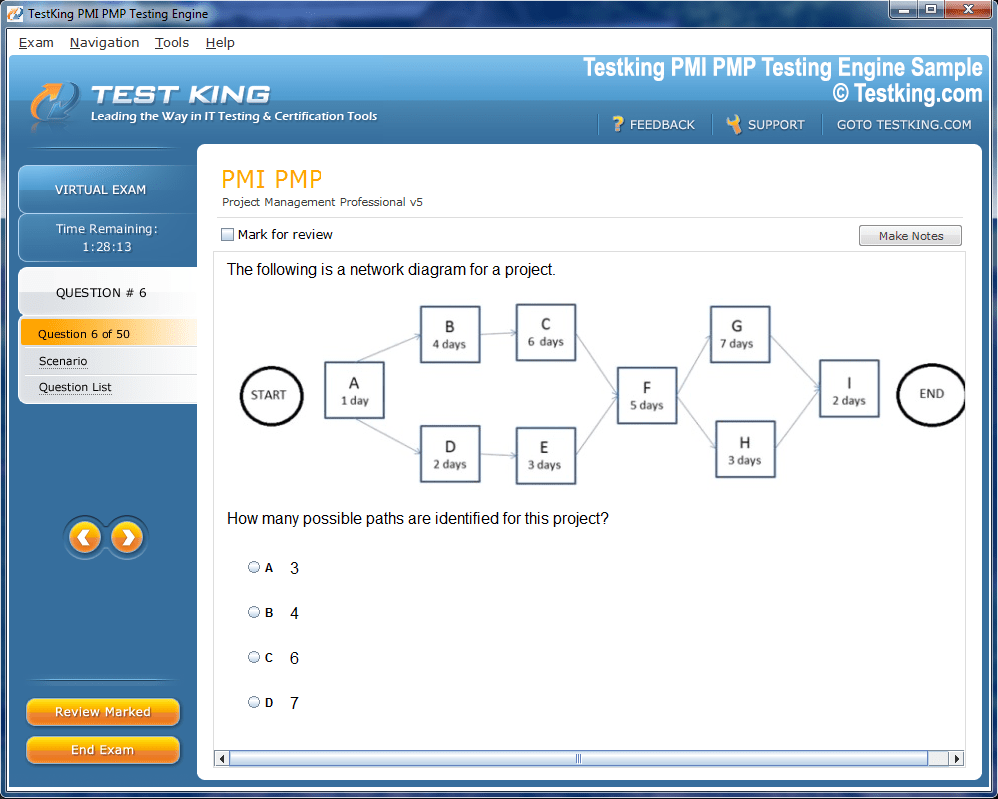
Product Screenshots



Frequently Asked Questions
Where can I download my products after I have completed the purchase?
Your products are available immediately after you have made the payment. You can download them from your Member's Area. Right after your purchase has been confirmed, the website will transfer you to Member's Area. All you will have to do is login and download the products you have purchased to your computer.
How long will my product be valid?
All Testking products are valid for 90 days from the date of purchase. These 90 days also cover updates that may come in during this time. This includes new questions, updates and changes by our editing team and more. These updates will be automatically downloaded to computer to make sure that you get the most updated version of your exam preparation materials.
How can I renew my products after the expiry date? Or do I need to purchase it again?
When your product expires after the 90 days, you don't need to purchase it again. Instead, you should head to your Member's Area, where there is an option of renewing your products with a 30% discount.
Please keep in mind that you need to renew your product to continue using it after the expiry date.
How many computers I can download Testking software on?
You can download your Testking products on the maximum number of 2 (two) computers/devices. To use the software on more than 2 machines, you need to purchase an additional subscription which can be easily done on the website. Please email support@testking.com if you need to use more than 5 (five) computers.
What operating systems are supported by your Testing Engine software?
Our 4A0-116 testing engine is supported by all modern Windows editions, Android and iPhone/iPad versions. Mac and IOS versions of the software are now being developed. Please stay tuned for updates if you're interested in Mac and IOS versions of Testking software.
Top Nokia Exams
- 4A0-D01 - Nokia Data Center Fabric Fundamentals
- 4A0-100 - Nokia IP Networks and Services Fundamentals
- 4A0-C03 - Nokia NRS II Composite: IS-IS version
- 4A0-112 - Nokia IS-IS Routing Protocol
- 4A0-104 - Nokia Services Architecture
- 4A0-116 - Nokia Segment Routing
- 4A0-AI1 - Nokia NSP IP Network Automation Professional Composite Exam
- 4A0-205 - Nokia Optical Networking Fundamentals
- 4A0-115 - Nokia Ethernet Virtual Private Network Services
- 4A0-D03 - Nokia SR Linux EVPN and Data Center Interconnect
- 4A0-103 - Nokia Multiprotocol Label Switching
- 4A0-107 - Nokia Quality of Service
- 4A0-114 - Nokia Border Gateway Protocol Fundamentals for Services
Unlocking the Core Skills for Nokia 4A0-116 Network Routing Mastery
Achieving mastery in network routing requires more than just technical familiarity; it demands a deep comprehension of architecture, protocols, and the systematic flow of data across diverse infrastructures. The Nokia 4A0-116 certification embodies the precision, intelligence, and capability expected from advanced networking professionals. This examination not only validates routing knowledge but also strengthens an engineer’s capacity to implement, configure, and manage robust service routing environments in a world driven by rapid data exchange and complex connectivity.
The significance of this certification lies in its design around real-world challenges faced in service provider and enterprise environments. It encompasses intricate routing theories, IP/MPLS architectures, advanced configuration management, and the integration of intelligent traffic engineering. Those pursuing the Nokia 4A0-116 path embark on a demanding yet rewarding expedition toward mastering network routing fundamentals and emerging technologies that redefine digital communication.
The contemporary landscape of networking is dominated by vast networks interlinking data centers, enterprises, and service providers. Within these infrastructures, routing plays an instrumental role in ensuring stable, predictable, and efficient data transmission. Understanding these principles forms the cornerstone of any network engineer’s expertise, particularly for those advancing through the Nokia Service Routing Certification framework.
Understanding the Core Foundations of Network Routing
At the heart of the Nokia 4A0-116 certification lies the principle of routing intelligence — a concept that transcends basic path determination. Routing protocols operate like the nervous system of the internet, transmitting information about network topology, reachability, and path preferences. Every router functions as a decision-maker, continuously evaluating metrics to determine the most suitable route for packet delivery.
The examination of routing fundamentals delves into the mechanisms behind Interior Gateway Protocols (IGPs) such as OSPF and IS-IS, and Exterior Gateway Protocols (EGPs) like BGP. Each of these routing paradigms serves a specific function within hierarchical network designs. IGPs optimize internal communication, while BGP manages interdomain relationships essential for service providers and large-scale enterprises.
A crucial competence developed through the Nokia 4A0-116 framework involves comprehending how these protocols interoperate within a unified system. Engineers learn to configure route redistribution, policy control, and route filtering — operations that ensure seamless and efficient routing within complex topologies. These proficiencies prepare candidates for the practical aspects of maintaining scalable and resilient networks.
The Evolution of Service Routing Architectures
The modern digital ecosystem thrives on innovation in routing and switching. Traditional static routing models have evolved into dynamic architectures capable of intelligent decision-making and adaptive response. The Nokia 4A0-116 examination integrates this evolution into its conceptual and practical components, preparing professionals to navigate the convergence of IP and MPLS technologies.
Service routing architectures are distinguished by their emphasis on scalability, reliability, and service differentiation. Multiprotocol Label Switching (MPLS) serves as the backbone of such architectures, offering flexibility in traffic management and quality of service control. It enables traffic segregation through label-based forwarding, ensuring that specific service requirements are met with precision.
By mastering MPLS and its associated control protocols such as LDP and RSVP-TE, professionals gain insight into the art of engineering network performance. These protocols are not merely configurations but mechanisms that dictate how traffic flows across a network. The Nokia 4A0-116 curriculum immerses candidates in this realm, allowing them to translate theoretical principles into practical routing solutions adaptable to enterprise and carrier-grade networks.
Integration of IP and MPLS: A Foundational Perspective
The seamless fusion of IP and MPLS technologies defines the essence of modern service routing. Internet Protocol forms the structural framework, ensuring addressing and routing consistency, while MPLS introduces efficiency through label-based forwarding mechanisms. This integration provides a balance between speed and control, a vital requirement for high-performance networks.
Understanding the operation of MPLS involves recognizing its layered interactions. It functions between the traditional Layer 2 and Layer 3, earning it the designation of a “Layer 2.5” technology. Through label distribution, MPLS enables data packets to traverse predefined Label Switched Paths (LSPs), eliminating the need for repetitive route lookups at each hop. This process enhances forwarding speed and minimizes latency.
A network engineer pursuing Nokia 4A0-116 certification must internalize these concepts, as they underpin traffic engineering, VPN creation, and service segregation. By developing these proficiencies, one gains the capacity to manage intricate routing infrastructures capable of supporting voice, video, and data services simultaneously without compromising performance or reliability.
Routing Policy and Control Mechanisms
Routing without control mechanisms can lead to inefficiencies and instability. Routing policy defines how routes are selected, filtered, and distributed across different parts of a network. Within the Nokia 4A0-116 domain, understanding and applying routing policies is an essential competence.
Policies allow engineers to manipulate route advertisements based on administrative goals. They ensure compliance with organizational priorities, traffic management rules, and peering agreements. For instance, using policy statements, an administrator can prefer certain routes, apply metrics, or deny routes that could disrupt network harmony.
The mastery of policy configuration involves understanding route maps, filters, community tags, and preference attributes. In the context of BGP, these controls govern relationships between autonomous systems, enabling fine-grained traffic direction and balancing. Within IGPs, policies support internal optimization, ensuring that traffic flows follow the most efficient and stable paths.
Mastery of these policy mechanisms equips professionals with the ability to design networks that behave predictably, even under dynamic conditions. The Nokia 4A0-116 certification ensures candidates can implement and troubleshoot such policies with analytical precision.
Network Scalability and Hierarchical Design
As network infrastructures expand, scalability becomes a defining attribute of efficiency. Hierarchical network design introduces structured segmentation that simplifies management and optimizes routing performance. Nokia’s 4A0-116 framework integrates this architectural philosophy to help engineers construct networks that adapt fluidly to growth and complexity.
A scalable routing architecture typically follows a layered design approach, dividing the network into core, distribution, and access layers. Each layer serves a specialized function, reducing redundancy and improving fault isolation. The core layer focuses on high-speed transport, while the distribution layer manages policy enforcement and route summarization.
Hierarchical design also enhances network stability by containing routing updates within specific regions, preventing unnecessary propagation. In large-scale deployments, this approach significantly improves convergence times and minimizes CPU load on routers.
Through hands-on configuration and theoretical insight, the Nokia 4A0-116 curriculum cultivates expertise in applying these concepts to real-world environments. Candidates learn how to plan route aggregation, deploy redundant links, and ensure optimal path selection without overcomplicating network topology. This structural mastery is vital for organizations aiming to maintain operational efficiency amid expansion.
The Strategic Role of Network Automation
Network automation represents a transformative movement within the routing landscape. The Nokia 4A0-116 certification encourages professionals to develop a foundational understanding of automation principles, particularly in configuration consistency and service provisioning. Automation reduces manual intervention, minimizes configuration errors, and accelerates service deployment.
Within service routing, automation tools enable centralized control, facilitating the management of thousands of devices with coherent configuration policies. By adopting programmatic interfaces such as NETCONF and RESTCONF, network administrators can dynamically adjust routing parameters, implement policy changes, and monitor network health in real time.
Automation also complements routing by supporting rapid fault isolation and self-healing mechanisms. Through telemetry and analytics, automated systems detect anomalies and respond to disruptions, maintaining network integrity without human delay. For engineers preparing for Nokia 4A0-116, understanding automation not only enhances operational efficiency but also aligns their expertise with emerging network paradigms.
Troubleshooting and Performance Optimization
Troubleshooting remains a cornerstone skill in routing mastery. Even the most meticulously configured networks encounter anomalies, making diagnostic proficiency indispensable. The Nokia 4A0-116 framework integrates troubleshooting strategies into its core learning path, equipping professionals to identify, analyze, and resolve routing inconsistencies efficiently.
Effective troubleshooting begins with systematic observation. Engineers utilize routing tables, protocol adjacencies, and path traces to isolate root causes. Understanding the behavior of control plane and data plane operations becomes pivotal in this process. Control plane issues typically relate to protocol misconfigurations or adjacency failures, while data plane issues often involve forwarding or encapsulation errors.
Performance optimization follows naturally once the underlying issues are addressed. Engineers refine metrics, adjust policies, and enhance route redistribution to ensure optimal traffic distribution. By mastering these techniques, candidates strengthen their ability to maintain high availability and consistency across expansive network infrastructures.
Building a Resilient Network Mindset
Beyond configuration and protocol knowledge, network resilience represents a philosophical approach to design. It involves anticipating failures, planning redundancies, and maintaining continuity even under adverse conditions. The Nokia 4A0-116 certification cultivates this mindset by emphasizing redundancy, convergence, and failover principles.
Resilient networks employ multiple paths and backup mechanisms to sustain connectivity during failures. Fast reroute techniques and protocol-level recovery strategies minimize downtime and ensure service persistence. Engineers trained under this framework learn to balance redundancy with efficiency, creating architectures that deliver reliability without excessive resource consumption.
A resilient network mindset also involves proactive monitoring, risk assessment, and adaptability. Professionals who internalize these principles contribute to infrastructures capable of withstanding technological disruptions and scaling with evolving digital demands.
Advanced Routing Concepts and Intelligent Network Behavior
The sophistication of modern routing extends far beyond static configurations and predefined policies. It involves the orchestration of multiple protocols, adaptive decision-making, and the seamless exchange of information across heterogeneous systems. Within the Nokia 4A0-116 framework, the focus on advanced routing principles refines the engineer’s perception of how dynamic networks function, evolve, and sustain operational harmony.
At its core, advanced routing represents a convergence of control and precision. Network devices communicate continuously, adapting to topological shifts and performance variations. Routing decisions no longer rely solely on static routes or cost metrics; they encompass a deeper comprehension of service demands, link characteristics, and administrative intents. Engineers learn to interpret these factors within an integrated environment that balances efficiency and stability.
Dynamic behavior in routing ensures that networks remain responsive to failures, congestion, and fluctuating demand. Protocols such as OSPF and IS-IS play crucial roles in maintaining these adaptive mechanisms, recalculating paths based on link states and topology changes. This dynamic recalibration epitomizes the essence of an intelligent network, capable of reorganizing its own structure to preserve optimal functionality.
The Nokia 4A0-116 curriculum delves into this domain of dynamic routing intelligence, preparing professionals to design systems that embody both flexibility and predictability — two traits essential for the networks that power modern communication.
Deep Dive into Interior Gateway Protocols
Interior Gateway Protocols form the internal bloodstream of an autonomous system. Their role extends beyond path selection; they establish consistency, reliability, and reachability within the network’s interior structure. In the Nokia 4A0-116 study path, a significant emphasis is placed on understanding the inner mechanics of these protocols, particularly OSPF and IS-IS, and how they facilitate the propagation of routing intelligence.
OSPF, or Open Shortest Path First, operates using a link-state model where each router constructs a detailed map of the network’s topology. This comprehensive awareness enables the router to compute the shortest path tree to every destination, ensuring optimal route selection based on cost metrics. Engineers learn to interpret OSPF areas, designated routers, and LSAs, recognizing how each component influences scalability and stability.
IS-IS, by contrast, presents a more hierarchical approach, often favored in carrier-grade environments. It offers scalability and protocol independence, operating natively over Layer 2 without the overhead of IP encapsulation. Within Nokia’s Service Routing ecosystem, IS-IS is particularly valued for its robustness and adaptability in large-scale deployments.
Mastering these protocols involves understanding adjacency formation, database synchronization, and SPF calculations. Engineers must also recognize the impact of area design, route summarization, and authentication in ensuring efficiency and security. The ability to analyze OSPF and IS-IS interactions defines a critical milestone in the Nokia 4A0-116 journey, cementing one’s foundation in internal network dynamics.
The Art and Science of Exterior Gateway Protocols
While IGPs sustain internal operations, Exterior Gateway Protocols, primarily BGP, manage communication across autonomous systems. The Nokia 4A0-116 certification cultivates an advanced understanding of BGP as both an art and a science. It is not merely about exchanging routes but about shaping global connectivity through policy-driven routing.
BGP functions through a system of path attributes, enabling granular control over route selection and advertisement. Engineers must learn how attributes such as AS-Path, MED, and Local Preference influence routing decisions. Unlike IGPs, which focus on rapid convergence, BGP prioritizes stability and policy adherence, reflecting its role in interdomain communication.
One of the defining aspects of BGP mastery lies in its scalability and policy control. In large-scale service provider environments, thousands of prefixes may traverse the network simultaneously. Efficient route filtering, aggregation, and path selection become vital to maintaining manageable and coherent routing tables.
The Nokia 4A0-116 examination challenges candidates to configure, analyze, and troubleshoot complex BGP scenarios, ensuring they can manipulate routing behaviors to align with business objectives. This understanding empowers network professionals to operate confidently in interconnected, multi-domain environments where precision and stability are paramount.
Route Redistribution and Inter-Protocol Coordination
A central challenge in routing arises when multiple protocols coexist within a single network infrastructure. Each protocol maintains its own topology database and metrics, often leading to discrepancies when routes must cross protocol boundaries. Route redistribution addresses this challenge by enabling controlled exchange of routing information between protocols such as OSPF, IS-IS, and BGP.
In the context of the Nokia 4A0-116 curriculum, route redistribution is more than a technical exercise — it is a strategic decision-making process. Engineers must evaluate the implications of metric translation, routing loops, and policy enforcement to ensure seamless integration. Careless redistribution can lead to route instability, oscillations, or suboptimal path selection.
Redistribution policies employ route maps and filters to determine which routes should be exchanged and under what conditions. Administrative distances, route tags, and metric recalculations further refine control over these interactions. By mastering these subtleties, professionals gain the ability to harmonize hybrid environments where multiple routing protocols operate in tandem.
Through hands-on configuration and theoretical insight, candidates learn to orchestrate this inter-protocol coordination with surgical accuracy. This competence reflects the precision required of an expert in service routing architecture and distinguishes those who can maintain order within complex, multilayered topologies.
MPLS and Traffic Engineering Principles
Multiprotocol Label Switching remains a cornerstone technology in service provider networks. Its significance within the Nokia 4A0-116 framework cannot be overstated, as it bridges the efficiency of IP routing with the determinism of circuit switching. MPLS introduces the concept of label-switched paths, which guide packets based on short labels rather than lengthy IP lookups, accelerating the forwarding process.
MPLS traffic engineering enhances this concept by providing control over how traffic flows through the network. Instead of relying solely on IGP-determined shortest paths, traffic can be directed along optimized routes that account for bandwidth availability, latency, or policy constraints. This ensures better utilization of network resources and improved service quality for end-users.
Engineers must understand the interplay between Label Distribution Protocol (LDP), Resource Reservation Protocol with Traffic Engineering (RSVP-TE), and Interior Gateway Protocols. LDP automates the establishment of label-switched paths, while RSVP-TE enables explicit path control and bandwidth reservation. Together, they form the foundation for predictable and manageable data transport.
The mastery of MPLS and its control mechanisms empowers professionals to design networks that are both high-performing and resilient. It enhances their ability to deliver services such as Layer 3 VPNs, pseudowires, and traffic-segregated virtual networks — capabilities that are indispensable in carrier-grade infrastructures.
Quality of Service and Traffic Prioritization
In a world where data types vary dramatically in sensitivity and performance demands, Quality of Service (QoS) becomes a decisive element of routing mastery. The Nokia 4A0-116 examination incorporates QoS principles to ensure that candidates can manage latency-sensitive and bandwidth-intensive applications with precision.
QoS operates through classification, marking, queuing, and scheduling. Packets are categorized according to their type and assigned priority levels through markings such as Differentiated Services Code Point (DSCP). Routers then allocate resources accordingly, ensuring that voice and video streams receive preferential treatment over less time-sensitive traffic.
Queue management and scheduling algorithms, such as Weighted Fair Queuing (WFQ) and Priority Queuing (PQ), further enhance traffic differentiation. These techniques prevent congestion and maintain consistent throughput across diverse service categories.
Engineers pursuing the Nokia 4A0-116 certification must understand how QoS interacts with MPLS and IP routing. By combining traffic engineering with QoS mechanisms, they can achieve end-to-end performance assurance, fulfilling service level agreements and optimizing the overall network experience.
Multicast Routing and Efficient Data Distribution
Efficient data distribution is a defining characteristic of modern networking. Multicast routing enables a single source to transmit data to multiple receivers simultaneously without redundant replication across links. This capability is indispensable for applications such as video conferencing, live streaming, and real-time data dissemination.
The Nokia 4A0-116 syllabus explores multicast routing as a core concept. It introduces protocols such as Protocol Independent Multicast (PIM) and Internet Group Management Protocol (IGMP), which coordinate group membership and tree construction. Engineers must understand the operational differences between dense and sparse mode multicast, as well as the role of Rendezvous Points in facilitating source discovery.
Multicast efficiency relies on building optimized distribution trees, either shortest-path or shared, depending on the network’s design and scale. The ability to manage these trees ensures bandwidth conservation and synchronization across recipients.
By mastering multicast mechanisms, professionals enhance their capability to deliver large-scale, bandwidth-sensitive services with agility and reliability. This competence aligns perfectly with the objectives of the Nokia 4A0-116 certification, where routing mastery extends into every aspect of network functionality.
Route Optimization and Convergence Techniques
The effectiveness of a routing system is measured not only by its correctness but also by its responsiveness. Convergence — the process through which routers agree on the current network topology — is crucial for maintaining consistent connectivity. Slow convergence can result in packet loss, instability, and degraded performance.
In the Nokia 4A0-116 framework, route optimization and convergence are studied in detail. Engineers learn how protocol timers, hold intervals, and SPF algorithms influence convergence speed. Adjusting these parameters intelligently ensures that networks remain both stable and responsive.
Optimization also involves reducing unnecessary recalculations, implementing summarization, and deploying route dampening mechanisms. These techniques balance agility with predictability, preventing oscillations that could destabilize large networks.
Through mastery of convergence principles, professionals gain the insight required to construct networks that recover gracefully from failures and adapt swiftly to change. This level of proficiency is a defining characteristic of advanced network routing expertise.
Ensuring Network Security within Routing Environments
Routing security is a paramount consideration in modern infrastructures. With the increasing complexity of interconnections, vulnerabilities such as route hijacking, spoofing, and unauthorized advertisements have become genuine threats. The Nokia 4A0-116 certification embeds security awareness within its routing curriculum, emphasizing both prevention and mitigation strategies.
Authentication mechanisms, including MD5 and HMAC, safeguard protocol exchanges, ensuring that only trusted peers participate in routing updates. Route filtering further enforces security by controlling which prefixes enter or exit the network. Additionally, prefix limits and policy enforcement protect routers from overload and malicious configuration attempts.
At a strategic level, engineers must adopt a defense-in-depth approach, combining protocol-level protections with infrastructure hardening and continuous monitoring. Understanding the subtleties of control plane policing and prefix validation enhances network resilience against sophisticated threats.
By integrating these principles into their routing practices, certified professionals fortify the reliability of their infrastructures, aligning performance with security in a balanced and sustainable manner.
The Framework of Network Virtualization in Modern Routing
Virtualization has transformed the landscape of networking by introducing abstraction, flexibility, and resource optimization. Within the Nokia 4A0-116 certification, virtualization is explored not as an isolated technology but as an integrated element of service routing architecture. It encapsulates the methods by which physical infrastructures are divided into independent, manageable virtual environments capable of hosting diverse services and customers simultaneously.
Network virtualization allows multiple routing instances to coexist on a single physical platform without interference. This evolution reflects a paradigm shift toward efficient utilization of hardware and optimized traffic segmentation. Through Virtual Routing and Forwarding instances, or VRFs, engineers gain the ability to isolate routing tables, enforce security boundaries, and maintain dedicated configurations for different services or clients.
In service provider environments, this capability is invaluable. By separating customer traffic within distinct VRFs, service providers can deliver tailored services while maintaining centralized control. The Nokia 4A0-116 framework examines how these virtual instances interact with MPLS, BGP, and policy-based routing, ensuring scalability without sacrificing performance.
Understanding virtualization in routing demands both conceptual clarity and technical dexterity. Engineers must grasp how logical segmentation interacts with control and forwarding planes, allowing for precise, autonomous traffic management across complex topologies.
Virtual Private Networks and Service Isolation
A natural progression from routing virtualization is the deployment of Virtual Private Networks. VPNs are central to service routing mastery, forming the backbone of secure, scalable connectivity between distributed sites or customers. The Nokia 4A0-116 curriculum integrates an extensive exploration of Layer 2 and Layer 3 VPN models, illustrating how these technologies enable service differentiation and traffic encapsulation.
Layer 3 VPNs, built on MPLS and BGP, represent one of the most widely used service models. Each customer is assigned a dedicated VRF, ensuring isolated routing domains while maintaining shared physical infrastructure. The Provider Edge routers play a pivotal role, maintaining per-customer routing tables and exchanging routes through MP-BGP sessions.
Layer 2 VPNs, by contrast, emulate point-to-point or multipoint Ethernet services. These are established through mechanisms such as Virtual Private Wire Service (VPWS) and Virtual Private LAN Service (VPLS). These technologies extend customer networks transparently across service provider infrastructures, maintaining the illusion of a single cohesive LAN.
Engineers preparing for the Nokia 4A0-116 certification must develop an intricate understanding of how these VPN models operate, how they interact with underlying MPLS labels, and how control plane synchronization maintains forwarding consistency. Service isolation, redundancy, and scalability are achieved through the harmonious interplay of these principles.
Label Distribution and Control Plane Integration
The efficiency of MPLS-based routing relies on precise label distribution. Labels define the path packets will follow across the network, allowing forwarding to occur without complex lookups. Within the Nokia 4A0-116 framework, understanding how these labels are allocated, propagated, and maintained forms a vital component of the certification’s skillset.
Label Distribution Protocol (LDP) and Resource Reservation Protocol with Traffic Engineering (RSVP-TE) serve as the primary means of distributing labels. LDP automates the creation of label-switched paths, while RSVP-TE enables explicit route definition and bandwidth allocation. The interplay between these protocols defines the adaptability and determinism of MPLS routing.
Integration between LDP, IGPs, and BGP ensures that label mappings correspond accurately with routing information. Engineers must analyze how the control plane synchronizes these relationships to avoid inconsistencies or forwarding loops. This synchronization ensures that label-switched paths remain congruent with the routing topology.
Beyond static operation, label management also supports advanced features such as hierarchical LSPs and fast reroute mechanisms. These capabilities enhance scalability and resiliency, making MPLS networks both predictable and fault-tolerant. Professionals certified under Nokia 4A0-116 gain an advanced understanding of how label distribution underpins service delivery and path optimization.
Segment Routing and Network Simplification
As network environments evolve, the need for simpler, more deterministic routing mechanisms becomes apparent. Segment Routing (SR) represents a paradigm designed to replace traditional signaling protocols with a more streamlined approach. The Nokia 4A0-116 certification introduces this concept as part of the transition toward next-generation IP and MPLS architectures.
Segment Routing operates by embedding path information directly within the packet header. Rather than relying on per-flow signaling, it allows routers to interpret segment identifiers that define the traversal path. This method reduces protocol overhead, accelerates convergence, and simplifies traffic engineering.
Two primary models exist: Segment Routing over MPLS (SR-MPLS) and Segment Routing over IPv6 (SRv6). SR-MPLS utilizes label stacks to define paths, maintaining backward compatibility with existing infrastructures. SRv6, on the other hand, leverages IPv6 extension headers, enabling complete flexibility and programmability.
For professionals pursuing the Nokia 4A0-116 certification, mastering segment routing signifies an understanding of operational efficiency and architectural evolution. It empowers engineers to manage traffic flows through intelligent, controller-driven orchestration, ensuring the network can dynamically adjust to business and performance requirements.
Advanced Traffic Engineering and Network Optimization
Traffic engineering stands at the intersection of art and algorithm, combining analytics and configuration to achieve balanced network utilization. Within the Nokia 4A0-116 certification, advanced traffic engineering principles expand upon foundational MPLS knowledge to include optimization models that improve service delivery.
The goal of traffic engineering is to direct packets through optimal paths based not only on topology but also on resource utilization, latency, and service priority. By leveraging RSVP-TE, Constrained Shortest Path First algorithms, and path computation elements, engineers can ensure traffic follows designated tunnels that meet predefined performance metrics.
Effective traffic engineering also involves continual assessment and adjustment. Network analytics provide visibility into link utilization, congestion points, and flow patterns. Based on this data, engineers may reassign label-switched paths, modify bandwidth reservations, or implement adaptive routing algorithms.
By mastering these principles, professionals cultivate an ability to anticipate and mitigate performance degradation. This ensures not only network efficiency but also the predictability necessary for supporting high-value services across diverse environments.
Network Convergence and Redundancy Mechanisms
A network’s ability to recover from failure defines its quality and resilience. Convergence mechanisms and redundancy strategies lie at the heart of service reliability. The Nokia 4A0-116 certification examines these elements as indispensable components of advanced routing design.
Convergence time measures how quickly routers can recalculate optimal paths following a topology change. Protocol enhancements such as Bidirectional Forwarding Detection (BFD) significantly accelerate this process by detecting failures within milliseconds. By coupling BFD with IGPs and BGP, engineers can achieve near-instantaneous failover responses.
Redundancy is another essential factor. Dual-homing, equal-cost multipath routing, and link aggregation ensure that multiple routes are available for any given destination. This redundancy eliminates single points of failure and maintains consistent traffic flow during outages or maintenance.
Understanding the symbiosis between convergence and redundancy enables engineers to design infrastructures that sustain uninterrupted operation under dynamic conditions. Such proficiency embodies the resilience expected of a Nokia 4A0-116 professional, whose networks must remain unyielding amid the fluctuations of global communication.
The Role of Hierarchical and Distributed Architectures
Modern service routing does not rely solely on monolithic designs. Hierarchical and distributed architectures ensure that complexity is compartmentalized and control remains scalable. The Nokia 4A0-116 framework promotes an understanding of hierarchical routing as a means of maintaining order within expansive infrastructures.
In hierarchical models, networks are divided into multiple layers, each serving distinct functions. The core layer prioritizes high-speed transport, the aggregation layer enforces policy control, and the access layer connects end devices. This modular structure simplifies troubleshooting, enhances stability, and localizes routing updates.
Distributed architectures extend this concept further by decentralizing control planes. Routing intelligence is distributed across multiple nodes, each capable of autonomous decision-making. This approach enhances scalability and fault tolerance, as no single device represents a point of failure.
By mastering hierarchical and distributed design, engineers develop a strategic perspective of network orchestration. They learn to manage scale while preserving manageability, a skill that distinguishes service routing architects from routine operators.
Network Management and Operational Visibility
Operational excellence requires not only technical configuration but also meticulous oversight. Network management encompasses the continuous monitoring, analysis, and optimization of infrastructure performance. The Nokia 4A0-116 certification introduces management frameworks that reinforce proactive control.
Monitoring systems track metrics such as interface utilization, latency, packet loss, and routing stability. Engineers employ these insights to forecast potential issues and implement preemptive adjustments. Telemetry and streaming analytics represent the modern evolution of this process, providing near real-time visibility into network behavior.
Management also extends to configuration consistency. Automated provisioning systems and centralized controllers reduce human error and ensure uniform policy enforcement. Log analysis and event correlation contribute to situational awareness, enabling precise response to anomalies.
Professionals trained under this certification learn to blend analytical reasoning with operational intuition. They cultivate the discipline to maintain equilibrium between performance, reliability, and resource allocation, ensuring sustained network vitality.
Integrating Security and Reliability within Virtualized Environments
Virtualized infrastructures introduce new dimensions of risk that demand specialized protection strategies. The Nokia 4A0-116 curriculum emphasizes that security must be intrinsic, not additive. As routing instances multiply, so too must the measures ensuring their integrity.
Isolation between VRFs provides a foundational layer of defense. However, additional mechanisms such as route filtering, authentication, and encryption strengthen this perimeter. Control plane policing protects routers from malicious traffic, while access control lists regulate communication between virtual entities.
Engineers must also recognize the importance of redundancy in security. Backup control channels, secure management interfaces, and automated failover of authentication systems ensure that protection persists even during disruptions.
In mastering this synthesis of reliability and security, professionals learn to build virtualized environments that are as resilient as they are efficient. Such balance exemplifies the holistic competence that the Nokia 4A0-116 certification seeks to instill.
The Evolution of Network Control and Intelligent Design
Network routing has transcended its traditional definition as a mechanism for packet forwarding. In the modern era, routing represents intelligence, adaptability, and dynamic orchestration. The Nokia 4A0-116 certification encapsulates this evolution, guiding professionals to comprehend not only the structure of protocols but the philosophy that underlies their interaction and automation.
The concept of network control has become multifaceted. It encompasses the coordination between distributed devices, centralized management systems, and virtualized services. Engineers are required to understand how each control element contributes to a larger ecosystem of connectivity. The Nokia 4A0-116 curriculum examines this paradigm, highlighting how intelligence within the control plane ensures efficiency across global networks.
Modern control designs emphasize autonomy and awareness. Networks must recognize traffic patterns, adjust dynamically to congestion, and maintain balance across diverse links. This level of adaptability demands a profound grasp of routing logic, signaling processes, and programmable interfaces. Professionals preparing for Nokia 4A0-116 certification explore these dynamics to master the interrelation between design strategy and operational behavior.
The Architecture of Service Routing Platforms
Service routing platforms represent the tangible foundation upon which routing intelligence operates. These platforms are built with precision, designed to process vast amounts of data while maintaining predictable performance. The Nokia 4A0-116 certification introduces candidates to the structural and functional aspects of such systems, deepening their understanding of how architecture influences routing capability.
At the core of service routing architecture lies modularity. Control plane and data plane components are often separated, allowing independent processing and scalability. The control plane manages routing decisions, protocol operations, and table maintenance, while the data plane executes packet forwarding based on these instructions. This separation enhances performance and ensures stability even during control plane recalculations.
High-performance routing platforms utilize hardware acceleration through application-specific integrated circuits. These components optimize forwarding operations, enabling routers to manage terabits of traffic with minimal latency. Engineers must understand how forwarding engines, memory structures, and queuing systems interact to sustain throughput under varying loads.
Comprehending the architecture of service routing platforms allows professionals to align configuration practices with hardware capabilities, ensuring that each deployed service operates within optimal boundaries.
The Significance of Control Plane Efficiency
The control plane operates as the cognitive center of a routing system. Its efficiency directly influences convergence, stability, and responsiveness. In the Nokia 4A0-116 framework, understanding control plane performance extends beyond command familiarity—it involves a strategic appreciation of protocol interactivity and state management.
Every routing protocol contributes to control plane activity. OSPF maintains link-state databases, BGP exchanges prefix information, and LDP or RSVP-TE manage label signaling. These operations require memory, CPU cycles, and synchronization across distributed nodes. Overburdening the control plane with excessive updates or misconfigured adjacencies can result in instability and delayed convergence.
Efficient control plane design involves route summarization, policy-based filtering, and reduction of redundant updates. Engineers learn to segment routing areas, adjust protocol timers, and apply authentication measures to sustain predictable behavior. By optimizing these elements, they ensure that the control plane functions harmoniously with the data plane, maintaining equilibrium throughout the network.
Professionals certified under Nokia 4A0-116 gain the analytical ability to detect performance anomalies and implement preventive measures that preserve operational consistency.
Data Plane Functionality and Forwarding Integrity
If the control plane represents intellect, the data plane embodies execution. Its role is to forward packets according to the decisions made by routing algorithms. The Nokia 4A0-116 certification explores how this mechanism operates across various technologies and interfaces, emphasizing reliability and precision.
In high-capacity environments, the data plane must handle multiple streams of traffic simultaneously. Each packet undergoes a lookup process, where its destination address or label is matched to a forwarding entry. Hardware acceleration ensures that this process occurs at line speed, eliminating latency that could hinder performance.
Forwarding integrity depends on consistent synchronization with the control plane. Routing updates, label assignments, and policy adjustments must reflect accurately within forwarding tables. Discrepancies can lead to blackholes or routing loops, compromising service continuity.
Engineers studying for Nokia 4A0-116 learn to analyze these dependencies through diagnostic tools, tracing the flow of packets across physical and logical interfaces. They cultivate the discipline to validate configuration consistency, ensuring that every packet follows the intended path with deterministic reliability.
Quality Assurance and Performance Stability
A network’s success is measured not only by connectivity but by quality and predictability. Quality assurance forms an integral part of routing mastery, encompassing the processes that validate network performance under operational and stress conditions. The Nokia 4A0-116 certification situates these concepts at the core of professional competence.
Performance stability arises from balanced utilization of resources, minimal latency, and predictable convergence behavior. Engineers must monitor throughput, jitter, and packet loss to identify performance degradation before it impacts end users. Tools for traffic sampling, flow analysis, and telemetry collection provide insight into how routing decisions affect quality.
Quality assurance also includes proactive design choices such as redundancy planning, equal-cost multipath routing, and congestion management. These techniques sustain service continuity and guarantee consistent user experience even under high demand.
Professionals who understand the mechanics of quality assurance within routing frameworks develop infrastructures that exceed basic functionality. They cultivate reliability through foresight, ensuring that each routing decision contributes to stability and endurance.
Routing Policies as Instruments of Control
Routing policies form the linguistic foundation of network control. They define how information is distributed, prioritized, and filtered within and across routing domains. Within the Nokia 4A0-116 ecosystem, the mastery of policy design signifies a transformation from operator to architect.
Policies utilize match-action logic, where routes are evaluated based on attributes and corresponding actions are executed. Engineers can control which prefixes are advertised, which peers receive them, and what metrics influence their selection. This mechanism empowers networks to align traffic behavior with business intent.
Common attributes include route preference, AS-Path manipulation, community tagging, and prefix lists. Through these instruments, engineers can enforce compliance with routing agreements, shape inbound and outbound traffic, and mitigate route leaks.
Designing and maintaining routing policies requires both analytical rigor and strategic creativity. Professionals must anticipate the implications of policy changes and validate outcomes through consistent monitoring. By mastering this discipline, Nokia 4A0-116 candidates gain the ability to orchestrate routing ecosystems that respond intelligently to operational and administrative objectives.
Path Selection and Load Balancing Strategies
Path selection forms the essence of routing behavior. Networks must evaluate available routes and determine which path ensures the most efficient, reliable, and policy-compliant delivery. The Nokia 4A0-116 certification trains professionals to comprehend these mechanisms in depth, ensuring that routing outcomes reflect both performance and intention.
Load balancing enhances this process by distributing traffic across multiple equivalent paths. Equal-Cost Multipath routing, or ECMP, ensures that no single link becomes saturated while others remain underutilized. Engineers must understand the criteria that enable ECMP, including consistent hashing, per-flow balancing, and metric equivalence.
In cases where paths are not identical, weighted or policy-based load balancing may be applied. This approach assigns traffic proportionally based on bandwidth availability or predefined administrative weights. The goal is to achieve equilibrium between resource utilization and performance consistency.
By mastering path selection and load balancing techniques, professionals ensure that their routing architectures maintain fluidity without instability. This expertise fosters networks that adapt dynamically to load variations while sustaining predictable performance.
Monitoring Protocol Convergence and Operational Health
Monitoring stands as the silent guardian of network integrity. It provides visibility into routing behavior, enabling engineers to verify that configurations produce the expected results. The Nokia 4A0-116 curriculum emphasizes operational awareness as an essential component of network excellence.
Monitoring tools track adjacency states, protocol timers, and routing table changes. By analyzing these indicators, engineers can detect anomalies such as delayed convergence, flapping links, or misaligned metrics. These insights form the basis for troubleshooting and optimization.
Proactive monitoring extends beyond fault detection. It enables predictive analytics that anticipate performance degradation and trigger corrective measures before failures occur. Telemetry and event-driven systems contribute to this proactive philosophy, reinforcing the shift from reactive management to intelligent control.
Engineers equipped with this level of awareness ensure that routing systems remain transparent and accountable, transforming complexity into manageable precision.
Automation and Programmable Routing Environments
Automation has emerged as the cornerstone of efficiency within modern routing infrastructures. It eliminates repetitive tasks, reduces configuration errors, and accelerates network responsiveness. The Nokia 4A0-116 certification acknowledges automation as both a technical necessity and a strategic advancement.
Programmable interfaces such as NETCONF, RESTCONF, and gRPC facilitate direct communication between network elements and control systems. Engineers can script configurations, deploy updates, and modify policies dynamically. This level of control not only improves agility but also standardizes network behavior.
Automation frameworks integrate with orchestration platforms that manage multiple devices through centralized logic. They enable zero-touch provisioning, dynamic service deployment, and automatic recovery from faults. By mastering these capabilities, professionals evolve from manual operators to orchestrators of intelligent ecosystems.
The inclusion of automation principles within the Nokia 4A0-116 curriculum underscores a future where networks are self-regulating, self-correcting, and aligned with business agility.
The Art of Routing Security and Infrastructure Protection
Routing security has become a fundamental requirement in contemporary network engineering. As global infrastructures evolve and interconnectivity intensifies, the integrity of routing information defines the trustworthiness of the entire communication ecosystem. The Nokia 4A0-116 certification places strong emphasis on security mechanisms that preserve network stability and safeguard data transmission.
At its foundation, routing security is the discipline of protecting the control and data planes from manipulation, disruption, or exploitation. Protocol vulnerabilities, misconfigurations, and unauthorized access can transform routing devices into points of compromise. Engineers must cultivate a meticulous approach toward authentication, authorization, and integrity verification.
Security begins with access control. Only trusted devices and administrators should interact with routing platforms. Role-based permissions, encrypted management channels, and strong password policies serve as the first layer of defense. At the protocol level, authentication mechanisms such as MD5 or SHA-based keys ensure that only validated peers exchange routing information.
By adopting layered security designs, engineers create an environment where each routing interaction is verifiable and resilient to tampering. The Nokia 4A0-116 curriculum encourages this proactive mindset, recognizing that prevention is the most efficient form of protection.
The Integrity of Routing Protocol Exchanges
Routing protocols form the nervous system of the network. They exchange reachability information, construct topologies, and adapt to environmental changes. Any compromise in these exchanges can lead to misinformation, route hijacking, or traffic redirection.
To maintain integrity, engineers must deploy cryptographic authentication and peer validation. OSPF adjacency formation should rely on shared secrets, while BGP sessions require robust authentication policies. These measures ensure that routers communicate only with trusted neighbors, reducing exposure to spoofing attacks.
Route filtering further enhances integrity. By defining prefix lists and route maps, engineers determine which routes are acceptable and which must be discarded. This prevents unauthorized or incorrect routes from propagating through the network.
Loop prevention mechanisms such as AS-Path checks, route tagging, and origin validation protect against recursive advertisements. The Nokia 4A0-116 certification guides professionals through these technical intricacies, instilling precision and awareness in their routing designs.
Securing Control Plane Operations
The control plane, being the cognitive layer of network function, demands specialized security measures. Its processes govern routing, signaling, and synchronization. A compromised control plane can destabilize even the most robust infrastructure.
Engineers mitigate this risk by implementing control plane policing. This mechanism regulates the rate of control traffic, ensuring that malicious or excessive packets do not overwhelm processing capacity. Access control lists and classification filters further refine which packets are permitted to reach the control plane.
Segmentation of management and control traffic is equally vital. Out-of-band management networks ensure that administrative commands remain isolated from user traffic. Encryption technologies such as Secure Shell and Transport Layer Security provide confidentiality during remote access and configuration.
Within the Nokia 4A0-116 framework, engineers learn how to balance accessibility with protection, crafting environments that are both manageable and impenetrable. Security, when embedded into design, becomes an attribute of stability rather than a reactive measure.
Data Plane Defense and Forwarding Protection
The data plane, though primarily concerned with packet forwarding, can also be a vector for intrusion if left unprotected. Flood attacks, malformed packets, and denial-of-service campaigns target forwarding processes to exhaust resources.
Protection mechanisms include traffic classification, policing, and shaping. By limiting the rate of specific traffic types, routers can preserve bandwidth for legitimate flows. Hardware-based filters enable the rapid rejection of invalid packets, ensuring that performance remains unaffected.
Ingress and egress filtering further protect against spoofed addresses and unwanted communication. Engineers employ these techniques to enforce integrity at the perimeters of their networks. Consistent validation of source and destination identifiers prevents malicious redirection or reflection attacks.
Mastery of the Nokia 4A0-116 certification enables professionals to design data plane defenses that complement control plane protection, forming a cohesive shield around the network’s operational heart.
Redundancy as a Security Mechanism
Redundancy not only ensures availability but also contributes to security. When routing devices or links fail, traffic must reroute seamlessly without exposing the network to vulnerabilities. Redundancy planning, therefore, intertwines with both resilience and protection.
High availability designs often include dual-homed routers, diverse paths, and synchronized configurations. Protocols such as VRRP, MC-LAG, and Fast Reroute guarantee that failovers occur within sub-second intervals. Engineers must configure these systems meticulously to prevent loops and inconsistencies.
Synchronization of security states across redundant devices is equally essential. Firewalls, filters, and route policies should replicate accurately to maintain uniform protection after failover events. This consistency ensures that security is never compromised during transitions.
The Nokia 4A0-116 framework positions redundancy as a proactive defense strategy. By merging reliability with vigilance, engineers create networks that recover instantly without exposing weak points.
The Role of Policy in Network Defense
Routing policies do not merely control traffic—they also serve as instruments of defense. Through the careful manipulation of route attributes, engineers can prevent the propagation of unwanted information, isolate malicious peers, and shape inbound and outbound behavior to minimize exposure.
Policy-based controls define which routes enter the routing table and which remain filtered. They can modify local preferences, suppress certain advertisements, and restrict redistribution between protocols. These capabilities prevent unverified data from contaminating trusted domains.
Engineers can also employ policies to enforce geographical or logical boundaries, ensuring that sensitive routes are confined within specific segments of the network. Community tagging and route target filtering allow granular management of shared environments such as VPNs and multi-tenant systems.
Through policy-driven defense, professionals elevate routing from a reactive process to a preemptive guardian of network stability. The Nokia 4A0-116 certification integrates this philosophy, reinforcing that security and intelligence coexist within the same architectural framework.
Defensive Routing Protocol Enhancements
Modern routing technologies incorporate advanced features that enhance protection and verification. Mechanisms such as BGP Route Origin Validation, prefix filtering, and Resource Public Key Infrastructure (RPKI) prevent unauthorized route advertisements and improve traceability.
Engineers must understand the practical implementation of these systems. Origin validation confirms that prefixes originate from legitimate sources, while RPKI ensures that routing information can be cryptographically authenticated. Together, these mechanisms mitigate one of the most persistent threats—route hijacking.
Within internal domains, loop prevention and adjacency monitoring protect against accidental misconfigurations. Engineers can deploy bidirectional forwarding detection and hold timers to detect failures rapidly. These tools reinforce control plane integrity, ensuring that no unauthorized or unstable sessions persist.
The Nokia 4A0-116 certification cultivates familiarity with these contemporary defenses, transforming candidates into custodians of routing trust.
Security Through Operational Discipline
Beyond configuration and protocol mastery, security also depends on human precision. Operational discipline ensures that networks remain consistent, predictable, and auditable. Documentation, change management, and configuration versioning are essential practices that sustain trust within the infrastructure.
Routine audits verify that policies, access lists, and authentication mechanisms remain aligned with evolving standards. Engineers must adopt a continuous improvement mindset, refining configurations as technologies advance. Logging and monitoring systems capture every administrative action, creating transparency that deters unauthorized manipulation.
The Nokia 4A0-116 curriculum promotes this cultural aspect of routing security. It recognizes that the integrity of a network reflects not only its hardware and software but also the rigor of its custodians.
Managing Security Events and Network Resilience
When incidents occur, the ability to respond with accuracy and speed defines the outcome. Security event management integrates detection, containment, and recovery into a unified process. Engineers must interpret alerts, isolate affected systems, and restore normalcy without interrupting legitimate operations.
Incident response relies on predefined playbooks that outline step-by-step procedures for common threats. Coordination between teams ensures that actions remain synchronized and effective. Post-incident analysis identifies the origin and propagation of attacks, feeding insights back into future prevention.
Resilience depends on preparation. Backup configurations, redundancy, and failover testing ensure that recovery processes function seamlessly. The Nokia 4A0-116 framework encourages engineers to cultivate this readiness, transforming crisis response into a refined operational art.
Encryption and Confidentiality in Network Communication
While routing primarily concerns path determination, the confidentiality of transmitted data cannot be ignored. Encryption technologies protect the integrity and privacy of network communication across public and shared infrastructures.
IPsec, MACsec, and TLS provide encryption at various layers of the network stack. These systems ensure that even if data is intercepted, it remains unreadable to unauthorized entities. Key exchange mechanisms and certificate authorities underpin these encryption frameworks, maintaining authenticity and trust.
Engineers preparing for Nokia 4A0-116 certification learn how to integrate encryption into routing architectures without compromising performance. The harmony between speed and secrecy exemplifies the sophistication of modern network design.
The Transformation of Network Intelligence
The era of static and predictable routing has evolved into one defined by intelligent adaptability. Modern network routing demands not only precision in protocol configuration but also a holistic understanding of how systems respond to environmental shifts. The Nokia 4A0-116 certification captures this transformation by guiding engineers toward the mastery of routing intelligence, where logic, automation, and strategic foresight converge.
Intelligent routing involves the ability to interpret network conditions dynamically. It requires the fusion of telemetry, analytics, and real-time responsiveness. Engineers who achieve proficiency in this domain can anticipate congestion, reroute traffic preemptively, and optimize throughput based on live feedback. This capability transforms traditional routing into an adaptive organism capable of learning from its operational state.
The concept of network intelligence also encompasses intent-based design. Instead of manually defining configurations, engineers articulate objectives—such as performance thresholds, security constraints, and quality levels—and allow the system to calculate the optimal configuration automatically. The Nokia 4A0-116 framework encourages this mindset, preparing professionals for an era where networks act autonomously yet remain fully transparent in their decisions.
The Influence of Virtualization and Cloud Integration
Virtualization has reshaped the architecture of service routing. Network functions that once required dedicated hardware now operate within virtualized environments, increasing agility and scalability. The Nokia 4A0-116 certification explores how routing principles adapt to these paradigms, where resources can be dynamically allocated, replicated, or migrated across data centers.
Virtual routers, service gateways, and overlay tunnels define the landscape of modern routing infrastructures. These components operate atop physical transport layers, abstracting complexity while enhancing flexibility. Engineers must understand how encapsulation, segmentation, and orchestration govern the performance of these virtual systems.
Cloud integration extends these capabilities even further. Routing within multi-cloud environments introduces challenges of interoperability, latency management, and security consistency. The ability to design policies that operate seamlessly across diverse platforms distinguishes advanced network professionals. The Nokia 4A0-116 framework equips engineers with this insight, enabling them to orchestrate connectivity that transcends geographical and technological boundaries.
Automation and the Shift Toward Self-Organizing Networks
Automation has transitioned from convenience to necessity. Networks are now too vast and intricate to be managed manually. The emergence of self-organizing networks represents a culmination of automation, analytics, and intent-based design.
In a self-organizing environment, the network configures, optimizes, and heals itself. It monitors its own performance metrics, identifies anomalies, and applies corrective actions without direct human intervention. This level of autonomy demands a deep foundation in routing logic, scripting, and programmable interfaces—all of which are emphasized within the Nokia 4A0-116 curriculum.
Engineers must learn to define automation workflows that align with operational policies. They integrate APIs, utilize configuration templates, and leverage telemetry-driven triggers to maintain balance between flexibility and control. The result is a network that evolves with minimal human input, reducing error margins and increasing agility.
The progression toward self-organizing systems reflects a shift in professional roles. Engineers move from manual operators to strategic designers who guide network behavior through rules and intentions rather than commands.
Performance Analytics and Predictive Routing
Data-driven intelligence has become an integral part of routing mastery. Analytics platforms collect metrics from every layer of the network, enabling engineers to interpret patterns and make informed decisions. Predictive routing extends this capability by using analytical models to forecast traffic trends and adjust paths before issues arise.
Through telemetry streams, routers transmit performance indicators such as latency, jitter, and throughput. These metrics feed into analytics engines that visualize real-time health and historical trends. Predictive algorithms analyze these patterns, suggesting or implementing changes that enhance efficiency.
For Nokia 4A0-116 professionals, understanding predictive routing represents a convergence of mathematics, statistics, and engineering. It transforms reactive troubleshooting into proactive optimization. Such foresight ensures that routing paths remain optimal even as demand fluctuates, traffic surges, or topology changes.
Predictive intelligence marks the beginning of a new era where networks no longer merely respond—they anticipate.
The Role of Policy-Based Automation
Policy-based automation merges the intelligence of policy control with the efficiency of automation frameworks. It empowers engineers to define high-level rules that dictate network behavior automatically. When these policies change, automation systems translate them into configurations across all relevant devices, ensuring consistency without manual effort.
This approach simplifies management and guarantees compliance with business intent. Policies can define routing preferences, security boundaries, and service-level expectations. Automation frameworks then interpret these parameters, applying them uniformly across distributed architectures.
Within the Nokia 4A0-116 context, policy-based automation reinforces the relationship between design intent and operational reality. Engineers gain the ability to modify entire infrastructures by adjusting a single logical rule, reducing time to implement changes while minimizing error potential.
This synthesis of policy and automation embodies the philosophy of modern routing mastery—precision achieved through abstraction and intelligence.
Integrating Artificial Intelligence into Routing Systems
Artificial intelligence has begun to reshape routing principles by introducing learning capabilities that extend beyond static algorithms. Machine learning models analyze vast datasets to predict failures, optimize paths, and enhance performance autonomously.
AI-driven routing systems continuously observe operational parameters. When anomalies occur, they compare historical behaviors to detect potential faults before they manifest. These systems also adapt routing metrics in real time, ensuring optimal utilization of resources.
Engineers pursuing Nokia 4A0-116 certification must grasp how AI integrates into traditional frameworks. They learn to interpret AI-generated insights, validate algorithmic decisions, and ensure that automated adjustments align with network policy. The collaboration between human intelligence and artificial cognition redefines efficiency, making networks self-optimizing entities.
AI does not replace human expertise—it amplifies it. The harmony between algorithmic precision and human oversight defines the future of network reliability.
Sustainable and Energy-Efficient Routing Architectures
As networks expand, energy efficiency and sustainability become essential engineering considerations. Routing infrastructures consume substantial power, and optimizing this usage is both an environmental and economic necessity.
Energy-efficient routing relies on intelligent power management. Devices can dynamically adjust performance based on demand, deactivating idle components during low utilization periods. Traffic engineering strategies also play a role by balancing workloads to minimize unnecessary energy expenditure.
Virtualization contributes to sustainability by consolidating resources and reducing hardware dependencies. Engineers must understand how to design architectures that achieve equilibrium between performance and efficiency.
The Nokia 4A0-116 certification promotes this philosophy of responsible design, recognizing that mastery involves not only technical excellence but also environmental consciousness.
The Human Element in Network Evolution
Despite automation, virtualization, and intelligence, the human element remains central to networking. Creativity, reasoning, and intuition guide decisions that machines cannot fully replicate. Engineers must maintain a balance between embracing automation and exercising judgment.
Effective communication, documentation, and collaboration ensure that teams remain synchronized even within automated environments. Continuous learning sustains relevance in a rapidly evolving field, allowing professionals to adapt to new technologies and methodologies.
The Nokia 4A0-116 framework fosters this adaptability, shaping engineers who combine analytical precision with creative vision. In the end, routing mastery extends beyond technical proficiency—it becomes an expression of intellectual craftsmanship.
Ethical Considerations in Intelligent Networking
As networks gain autonomy and intelligence, ethical responsibility becomes an intrinsic aspect of design. Decisions made by automated systems can influence accessibility, privacy, and fairness. Engineers must ensure that network policies reflect ethical standards and transparency.
Algorithmic bias, data collection practices, and decision-making transparency require deliberate oversight. Engineers must verify that automated systems act in alignment with established ethical frameworks. Accountability remains a cornerstone of trust, especially as networks impact critical infrastructures and global communication.
The Nokia 4A0-116 certification acknowledges this evolving dimension of professionalism, encouraging candidates to approach automation with moral awareness and technical discipline.
Through virtualization, predictive analytics, and policy-driven automation, routing transforms into an intelligent continuum that responds to the pulse of global connectivity. Professionals certified in Nokia 4A0-116 embody this transformation, mastering not only the protocols but the philosophies that shape the networks of tomorrow.
True mastery lies not in the repetition of commands but in understanding the harmony between technology, intelligence, and ethical design. With the principles of Nokia 4A0-116 as a foundation, engineers are prepared to guide the evolution of routing into an age defined by autonomy, precision, and conscious innovation.
Conclusion
The journey through unlocking the core skills for Nokia 4A0-116 Network Routing Mastery reflects the transformation of routing from a technical procedure into an art of intelligent design. Across its spectrum, this certification builds a foundation of precision, adaptability, and strategic thought that enables professionals to command the intricate balance between performance, security, and automation.
It empowers engineers to interpret network behavior dynamically, safeguard infrastructures with multilayered defense mechanisms, and design architectures that anticipate rather than react. Through the mastery of routing protocols, policy control, virtualization, and automation, candidates evolve into architects of intelligent connectivity who shape the flow of global communication with purpose and foresight.
Beyond configuration and protocol, Nokia 4A0-116 fosters an understanding of the philosophy guiding modern networks—where intelligence, sustainability, and ethical responsibility coexist. It cultivates the ability to transform data movement into a synchronized expression of innovation and trust. In essence, this mastery represents more than technical accomplishment; it signifies the evolution of engineering vision. Those who attain it stand at the intersection of logic and creativity, guiding networks into an era defined by autonomy, precision, and enduring excellence.